Moms Across America®®
Data Centers

Data Center Rules & Regulations: A State-by-State Guide

By: Sara Villani

The Federal Data Center Enhancement Act has now expired. Its governing provisions were repealed effective October 1, 2026, after Congress failed to enact an extension before the September 30 deadline. The law established baseline standards for certain federal data centers. It did not broadly regulate the private facilities driving the current AI buildout, even as calls for stronger protections are growing louder. In a September CNN/SSRS poll, nearly two-thirds of registered voters said AI and data centers would be an “extremely” or “very” important factor in their vote for Congress.

Moms Across America brought that call for stronger protections directly to Congress. Through one of our sign-on campaigns, hundreds of letters were sent to lawmakers urging them to extend the FDCEA until broader federal safeguards were in place. Zen and the YES MAAM team also traveled to Washington, D.C., meeting with legislators to raise awareness and call for stronger protections. Yet Congress has allowed even this limited framework to lapse, with no replacement in place or clear plan for stronger federal oversight.

And now that the FDCEA has expired, it is up to the states.

For residents facing a data center proposal, the questions are immediate: Will we have to pay for the electricity infrastructure that this AI needs? Will local water supplies be protected? What happens if neighbors experience persistent noise? Will residents have any meaningful say before a project is approved?

You should not need to become a legal expert to find answers. We have created this state-by-state guide to help you understand what protections exist where you live and where your lawmakers need to do more.

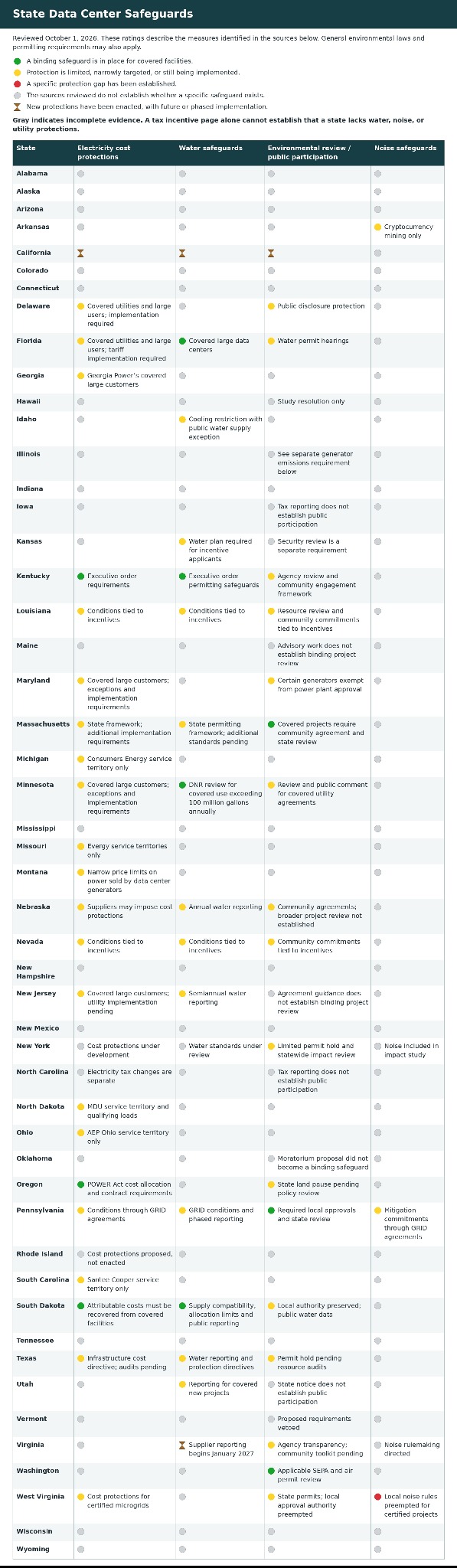
State Data Center Safeguards table, reviewed October 1, 2026

Rules by State

Reviewed October 1, 2026. These ratings describe the measures identified in the sources below. General environmental laws and permitting requirements may also apply.

Alabama

Statewide construction pause: None identified in this review.

What the state requires: Alabama’s identified data center provisions principally govern tax abatements. They include approval procedures and investment conditions. The Department of Revenue confirms that Act 2026-573 changes requirements for abatements granted beginning January 1, 2027; its guidance does not yet explain all those changes. These incentive conditions should be listed separately from environmental protections.

Suggested action: Ask lawmakers to establish clear electricity cost protections and public reporting of data center water use.

Alaska

Statewide construction pause: None identified in this review.

What the state requires: Alaska has general air permitting requirements for industrial emissions. These can be relevant to data center generators, but the cited program does not establish a separate data center oversight system or resolve the other checklist categories.

Suggested action: Ask lawmakers for a public inventory of data center projects and their electricity and water requirements.

Arizona

Statewide construction pause: None identified. A tax incentive application pause is in place.

What the state requires: HB 4168, Section 31, prevents new computer data center applications and new qualifications for the specified tax relief program from July 1, 2026, through June 30, 2029. This restricts tax benefits; it does not itself prohibit construction.

Suggested action: Ask lawmakers to pair incentive restrictions with enforceable water safeguards and electricity cost protections.

Arkansas

Statewide construction pause: None identified in this review.

What the state requires: Act 173 requires cryptocurrency mining businesses to use specified noise reduction measures and provides an enforcement route for certain nearby landowners. Those provisions apply to digital asset mining businesses. Could not locate equivalent protections for conventional or AI data centers.

Suggested action: Ask lawmakers to extend enforceable noise safeguards to conventional and AI data centers.

California

Statewide construction pause: None identified in this review.

What the state requires: Seven laws signed September 21, 2026 address electricity costs, resource use disclosures, water planning, utility rates, and environmental review. The package includes AB 1577, AB 2383, AB 2469, AB 2619, SB 886, SB 887, and SB 1168.

Timing matters: These are enacted laws, but their obligations have different start dates and implementation steps. For example, AB 2469 requires water supply information and developer responsibility for necessary water infrastructure improvements; its water scarcity plan requirement begins January 1, 2028. The new package should therefore carry an implementation label rather than an unqualified green light today.

Suggested action: Ask lawmakers and implementing agencies to make compliance information public and ensure the new requirements are enforced.

Colorado

Statewide construction pause: None identified in this review.

What happened to the proposed rules: HB 26-1030 and SB 26-102 both failed. Their proposed data center requirements cannot be counted as current protections. General permitting and utility requirements need a separate review before assigning ratings in those categories.

Suggested action: Ask lawmakers to introduce enforceable data center safeguards in the next legislative session.

Connecticut

Statewide construction pause: None identified in this review.

What the state requires: The qualified data center tax exemption program requires a state agreement and a negotiated agreement with the host municipality. The law provides consequences when agreement requirements are not met, including potential recovery of taxes. These are protections tied to the incentive program; they do not establish the environmental safeguards in the checklist.

Suggested action: Ask lawmakers to require resource use disclosures and protections against shifting infrastructure costs onto households.

Delaware

Statewide construction pause: No blanket pause identified. A narrower utility interconnection restriction was ordered.

What the state requires: The August legislation establishes cost protections for covered large energy users and requirements concerning their power supply. Implementation includes utility regulations and rate structures, so the electricity category receives yellow for now.

Public information: SB 312 prohibits state agencies, counties, and municipalities from entering certain nondisclosure agreements concerning data centers capable of using at least 100 MW. That is a transparency protection, not a comprehensive environmental review requirement.

Connection restriction: The cited PSC order requires an approved large load tariff before connecting covered new Delmarva Power customers of at least 25 MW. Because that order dates to September 2025, its current implementation status needs confirmation before describing the hold as ongoing.

Suggested action: Ask the PSC for public implementation updates and lawmakers for additional water and noise safeguards.

Florida

Statewide construction pause: None identified in this review.

What the state requires: SB 484 became law, generally effective July 1, 2026. Its electricity provisions cover qualifying customers with anticipated peak demand of at least 50 MW and require them to bear their full service costs. Utilities must file compliant tariffs for PSC approval by October 1, 2026. The law is enacted, but a filing deadline does not establish that every tariff has been approved.

Water protection: Covered large data centers face water permit safeguards, hearing requirements, and reclaimed water requirements when specified conditions are met. Those provisions support a green water rating for covered facilities and a yellow public participation rating because the identified hearing requirement concerns water permits.

Suggested action: Ask the PSC to publish tariff approvals and lawmakers to address noise impacts.

Georgia

Statewide construction pause: None identified in this review.

What the state requires: Georgia Power’s PSC approved rules address new customers using more than 100 MW. They provide for infrastructure cost responsibility, longer contracts, minimum billing, and PSC contract review. The yellow rating reflects their coverage of a specific utility.

Tax incentives: Georgia also has a separate equipment tax exemption with qualification and compliance requirements. That belongs in the incentives section rather than the environmental checklist.

Suggested action: Ask lawmakers for consistent protections across utility territories and public water use reporting.

Hawaii

Statewide construction pause: None identified in this review.

What the state requires: HCR 206 requests a working group to study large data center impacts on electricity customers, natural resources, and climate goals. It requests recommendations before the 2027 legislative session. The resolution does not itself establish a construction ban or binding operating standards.

Suggested action: Ask lawmakers to turn the study’s recommendations into enforceable safeguards, with public reporting of electricity and water demands.

Idaho

Statewide construction pause: None identified. A cooling water restriction applies to covered new facilities.

What the state requires: Covered data centers beginning construction on or after July 1, 2026, may not use water consumptively for cooling unless it comes from a municipal, water district, or water and sewer district system. The yellow rating reflects that exception and the law’s facility coverage. This is a restriction on the source of cooling water, rather than a complete prohibition on water consumption.

Suggested action: Ask lawmakers to require public water use reporting and safeguards for communities supplying water through public systems.

Illinois

Statewide construction pause: None identified. A tax incentive application pause is in place.

What the state requires: Illinois stopped processing applications for its data center incentive program on July 1, 2026. The program’s existing conditions include investment, employment, compensation, and carbon neutrality or qualifying green building certification. These conditions apply to program participants.

Additional air protection: Public Act 104-0458 establishes emissions standards for covered backup generator permit applications. Diesel generators must meet standards at least as protective as Tier 4, and natural gas generators must meet Tier 2 equivalent standards. These requirements apply beginning six months after the act’s June 1, 2026, effective date, so they receive an ⏳ implementation label as of this review. They should be tracked separately from environmental review and noise safeguards. DataCenterData

Suggested action: Ask lawmakers for enforceable water safeguards and ask environmental regulators to publish implementation guidance for the generator standards.

Indiana

Statewide construction pause: None identified in this review.

What the state requires: Indiana’s identified provisions concern participation in its data center sales tax exemption program. HEA 1210 adds a local payment mechanism for qualifying projects: quarterly payments may be required under an agreement with the host jurisdiction, calculated at no more than one percent of the state sales and use taxes avoided on electricity purchases. This is a local revenue provision, rather than a requirement protecting households from infrastructure costs.

Suggested action: Ask lawmakers to establish electricity cost protections and require public disclosure of projected water consumption.

Iowa

Statewide construction pause: None identified in this review.

What the state requires: Covered data centers claiming tax benefits must meet applicable investment requirements and register with the Department of Revenue. Annual reports are due January 31 and include information about electricity and backup generation fuel purchases. Failure to meet specified investment conditions can result in loss of the exemption and repayment of taxes. Reporting to the tax department does not itself establish public access to that information.

Suggested action: Ask lawmakers to make resource use information publicly accessible and establish water and electricity cost safeguards.

Kansas

Statewide construction pause: None identified in this review.

What the state requires: The SB 98 tax exemption program requires qualifying applicants to invest at least $250 million within five years, create 20 jobs for Kansas residents within two years, enter a 10-year electricity purchase agreement, adopt a comprehensive water plan, and undergo a security review.

Why water receives yellow: The water plan requirement applies to incentive applicants. The electricity purchase agreement should not automatically be described as a prohibition against shifting infrastructure costs onto households.

Suggested action: Ask lawmakers to extend water planning requirements beyond incentive participants and establish explicit electricity cost protections.

Kentucky

Statewide construction pause: No blanket pause identified. Executive order safeguards apply.

What the state requires: Executive Order 2026-494 requires developers to submit an energy plan demonstrating how existing electricity customers will be protected. It directs the Public Service Commission to prohibit utility rate increases that recover costs caused by data center development or operations. Its permitting framework also addresses harmful impacts on air quality, water, and natural resources.

Why the ratings differ: Electricity and water receive green for the identified executive requirements. Environmental review and public participation receive yellow because the framework relies on agency permitting and community engagement rather than establishing a uniform public approval process for every project.

Suggested action: Ask lawmakers to put these safeguards into statute and require public compliance reporting.

Louisiana

Statewide construction pause: None identified. Additional conditions apply to incentive participation.

What the state requires: Executive Order 26-058 directs Louisiana Economic Development to incorporate ratepayer and community protections into data center incentive agreements. The framework includes funding incremental power infrastructure, evaluating resource demands, improving efficiency, and making workforce and community commitments.

Why the ratings are yellow: These protections operate through incentive eligibility and contractual commitments. The order does not establish the same operating requirements for every data center regardless of incentive participation.

Suggested action: Ask lawmakers to extend these protections to all covered projects and require public reporting of compliance.

Maine

Statewide construction pause: None currently identified. The proposed moratorium did not become law.

What happened: LD 307 was vetoed, and the legislature failed to override the veto. It therefore cannot be counted as an active construction pause. mainelegislature.org

What the state enacted: Separate legislation, LD 713, excludes covered data centers from specified business equipment tax exemption and Dirigo incentive benefits and requires a study of financial incentives. It was signed April 23, 2026. These incentive restrictions do not establish the operating safeguards in the checklist.

Suggested action: Ask lawmakers to establish binding resource protections and a public review process before approving major projects.

Maryland

Statewide construction pause: None identified in this review.

What the state requires: The RELIEF Act establishes special utility treatment for covered large electricity customers, including cost allocation and financial safeguards. These include contractual commitments, exit fees, collateral, and protections when projects are delayed or canceled. Coverage depends on statutory demand criteria and exceptions for certain existing service agreements. The law also requires utility rate schedules and regulatory implementation.

Environmental review limitation: Separate legislation exempts certain emergency backup generating facilities from the power plant certificate approval process. That exemption should not be presented as a blanket exemption from environmental requirements.

Suggested action: Ask the PSC to publish implementation and compliance information, and ask lawmakers to address water use and noise impacts.

New Mexico

Statewide construction pause: None identified in this review.

What the review establishes: No comprehensive data center specific statewide operating framework was verified. The cited policy record identifies local actions and a project financing authorization, which should not be generalized into statewide requirements. Applicable state permitting and utility requirements still need to be checked for individual projects.

Suggested action: Ask lawmakers to establish electricity cost protections and require public disclosure of water demand.

New York

Statewide construction pause: An active, limited state permitting moratorium applies.

What the state requires: Executive Order 62 directs DEC to hold covered discretionary permit applications that were not complete before July 14, 2026. Covered facilities can consume at least 50 MW, with specified exclusions. The hold continues until submission of the final statewide environmental impact statement and findings report. It does not have a fixed one-year expiration.

Why the ratings differ: The order requires a statewide impact review with public comment and a public hearing. Electricity cost mechanisms and additional water standards remain under development. Studying noise does not itself establish an operating noise limit.

Suggested action: Participate in the state review and ask officials to adopt enforceable safeguards before lifting the permit hold.

North Carolina

Statewide construction pause: None identified in this review.

What the state requires: Session Law 2026-41 removes the electricity sales tax exemption for qualifying data centers and eligible internet data centers. Session Law 2026-42 requires electricity purchasers in those categories to report the amount of electricity tax paid within 30 days after each quarter. These are tax provisions, rather than water reporting or protections against shifting infrastructure costs onto households.

Suggested action: Ask lawmakers to establish explicit infrastructure cost protections and public resource use reporting.

North Dakota

Statewide construction pause: None identified in this review.

What the utility requires: Montana Dakota Utilities’ Rate 45 treats qualifying high density customers as a separate service class. A filing published by the state Public Service Commission explains that these customers pay the incremental costs of their service. Coverage depends on the utility territory and qualifying load characteristics.

Why electricity receives yellow: The identified protection applies through a particular utility tariff, rather than a uniform requirement covering every data center statewide.

Suggested action: Ask regulators to establish consistent cost protections across utilities and require disclosure of projected water consumption.

Ohio

Statewide construction pause: None identified. A separate pause on new tax exemption proposals was announced.

What the utility requires: AEP Ohio’s approved tariff requires covered large new data centers to pay for at least 85 percent of their subscribed capacity, with different treatment for smaller facilities. It also requires financial viability and includes exit fees for canceled projects or unmet contractual obligations. These requirements apply within AEP Ohio’s service territory.

Tax incentive pause: The governor’s May 27 announcement directed the Tax Credit Authority to stop accepting new data center tax exemption proposals after its scheduled meeting. This restricts access to incentives; it is not a construction ban.

Suggested action: Ask lawmakers to extend electricity cost protections statewide and establish water and noise safeguards.

Oklahoma

Statewide construction pause: None identified. SB 1488 should not be presented as an active ban.

What happened: SB 1488 proposed a construction moratorium and a study of data center impacts. The official legislative history shows committee referrals and subsequent sponsorship activity, rather than enactment. Its proposed restrictions do not establish current operating safeguards.

Suggested action: Ask lawmakers to establish enforceable resource protections and public review requirements for major projects.

Oregon

Statewide construction pause: A limited pause applies to requests involving state owned land.

What the pause covers: Agencies must pause unapproved requests for easements, leases, land use permissions and other specified transactions involving state property for data center projects. The pause runs through July 1, 2027, unless changed by subsequent state action. It is not a statewide ban on development on private land.

What the state requires: The POWER Act requires separate utility treatment for covered facilities using or capable of using at least 20 MW. It directs cost allocation to those customers and requires qualifying electricity service contracts lasting at least 10 years, with minimum payment obligations. Coverage and tariff implementation provisions matter.

Suggested action: Track utility implementation and ask lawmakers to establish water safeguards and clear public review requirements.

Pennsylvania

Statewide construction pause: No blanket ban identified. Stricter permitting procedures apply.

What the state requires: Executive Order 2026-05 establishes different review procedures for covered projects exceeding 25 MW depending on whether developers execute binding GRID agreements. Projects must obtain applicable local approvals. Nonparticipants face additional prerequisites and consolidated state review. Data centers are excluded from Permit Fast Track, and agencies under the governor cannot use project nondisclosure agreements.

Why some ratings are yellow: GRID agreements establish electricity cost commitments and water conservation requirements. The GRID framework also calls for community agreements addressing noise mitigation. These contractual protections should not be described as identical operating standards for every facility.

Reporting implementation: Annual energy and water reports begin July 1, 2027, receiving an ⏳ implementation label as of this review.

Suggested action: Ask DEP to publish executed agreements and compliance results, including measurable water and noise commitments.

Rhode Island

Statewide construction pause: None identified in this review.

What was proposed: S 2776 and H 7331 proposed requiring covered data centers to fund electricity infrastructure improvements. The reviewed histories show both measures held for further study, rather than enacted. Their proposed requirements therefore cannot be counted as current electricity cost protections.

Suggested action: Ask lawmakers to advance enforceable infrastructure cost protections and add public water use reporting.

South Carolina

Statewide construction pause: None identified in this review.

What the utility requires: Santee Cooper’s large load tariff establishes service agreements, minimum billing, and additional charges for covered customers. Conventional data centers generally fall within its large load category when monthly maximum demand exceeds 50 MW. Applicability depends on the tariff’s customer and service requirements.

Why electricity receives yellow: These requirements apply through Santee Cooper’s service arrangements, rather than a uniform statewide standard. Separate tax exemption eligibility rules should not be treated as environmental safeguards.

Suggested action: Ask lawmakers and regulators to extend cost protections across utilities and establish enforceable water and noise safeguards.

South Dakota

Statewide construction pause: None identified in this review.

What the state requires: SB 135 covers data centers with peak demand of at least 10 MW. Electricity providers must establish separate service terms recovering attributable costs, including costs left behind when a facility departs or substantially reduces its load.

Before operation, covered facilities must obtain water supply compatibility determinations. Water allocations must protect residential and essential public services. Operators must submit semiannual water reports, with usage data made public. The law also preserves local authority to regulate or prohibit data centers.

Suggested action: Ask regulators to publish service terms, water determinations, and compliance information.

Tennessee

Statewide construction pause: None identified in this review.

What the state requires: The qualified data center tax program generally requires investment exceeding $100 million over three years, at least 15 new jobs, and wages meeting the program threshold. Benefits include exemptions for qualifying equipment and reduced sales tax on electricity. These are incentive eligibility conditions, rather than the operating safeguards measured in the table.

Suggested action: Ask lawmakers to connect tax benefits to electricity cost protections and public water use reporting.

Texas

Statewide construction pause: An active state permit and regulatory approval hold applies.

What the state requires: The September 21 directive halts TCEQ permits sought by data centers and prevents state agencies from advancing regulatory approvals until required audit information is obtained. It directs agencies to address electricity infrastructure costs, grid reliability, community water supplies, and resource use reporting. Additional statutory safeguards are contemplated.

Important timing distinction: October 19 is TCEQ’s deadline to provide a compliance update. It is not an automatic expiration date for the hold.

Suggested action: Ask agencies to publish audit findings and the enforceable conditions required before approvals resume.

Utah

Statewide construction pause: None identified. Water reporting applies to covered new projects.

What the state requires: Beginning July 1, 2026, new data centers larger than 10,000 square feet that intend to withdraw at least 75 acre feet annually must submit information 90–360 days before construction. Operational reports are due July 1 each year. Facilities operating or under construction before the effective date are exempt.

Annual withdrawal amounts must be published, although other information may qualify for confidentiality protection.

Why water receives yellow: Reporting improves transparency but does not itself establish a water consumption cap.

Suggested action: Ask lawmakers to extend reporting to existing facilities and establish safeguards for stressed water supplies.

Vermont

Statewide construction pause: None identified in this review.

What happened: H.727, concerning sustainable data center deployment, was vetoed. The attempted override failed on May 29, 2026. Its proposed data center requirements therefore did not become law and cannot be counted as enacted safeguards.

Suggested action: Ask lawmakers to advance enforceable electricity cost protections and resource reporting requirements.

Virginia

Statewide construction pause: None identified in this review.

What the state requires: Executive Order 22 limits new state agency nondisclosure agreements concerning data center impacts and directs development of a community planning toolkit. It also directs additional work on noise regulations, cooling water scarcity, and cumulative generator impacts. These directives should be distinguished from completed operating regulations.

Additional air protection: For covered permit applications submitted on or after July 1, 2026, generator emission limits must be at least as protective as Tier 4 equivalent controls. This is a binding emissions requirement, separate from noise safeguards.

Water reporting implementation: Beginning January 1, 2027, covered water suppliers must separately report water supplied to qualifying data centers. This receives an ⏳ implementation label as of this review.

Suggested action: Track noise rulemaking and ask DEQ to publish accessible water reporting and generator compliance information.

Washington

Statewide construction pause: None identified in this review.

What the state requires: Data centers face applicable State Environmental Policy Act review and air permitting for backup generators. Where required, Ecology reviews health impact assessments before issuing construction permits. The agency also evaluates combined generator pollution impacts.

Separate incentive conditions: The equipment tax exemption program includes employment and compensation requirements, along with construction and environmental qualifications. These conditions should not automatically be treated as electricity cost or water consumption safeguards.

Suggested action: Participate in applicable environmental review and ask lawmakers for explicit electricity cost and water safeguards.

West Virginia

Statewide construction pause: None identified. Special certification and microgrid rules apply.

What the state requires: HB 2014 establishes a framework for certified high impact data centers and associated microgrids. The data center definition includes an aggregate critical IT load of at least 90 MW. For microgrid districts, specified electricity infrastructure and service costs must be borne by generators or customers within the district, rather than other regulated utility customers.

Public review limitation: Certified projects are exempt from specified local zoning, permitting, and approval requirements. State environmental requirements remain applicable.

Why noise receives red: The law expressly exempts certified projects from local noise ordinances. This rating identifies that specific removal of protection.

Suggested action: Ask lawmakers to restore local approval and noise authority while retaining electricity cost protections.

Wisconsin

Statewide construction pause: None identified in this review.

What the state requires: Data centers must obtain Wisconsin Economic Development Corporation certification before claiming the equipment sales and use tax exemption. Eligibility includes qualifying investment requirements. Recipients must retain required records and their WEDC agreement. Revocation of certification ends eligibility for subsequent exempt purchases. These are incentive program conditions, rather than the operating safeguards measured in the table.

Suggested action: Ask lawmakers to connect incentives to electricity cost protections and enforceable water safeguards.

Wyoming

Statewide construction pause: None identified in this review.

What the state requires: Wyoming provides tax exemptions for qualifying data processing equipment purchases. Eligibility depends on statutory investment and purchase conditions, with different provisions for computer equipment and power or cooling infrastructure. These incentive conditions do not establish comprehensive water or noise safeguards.

Suggested action: Ask lawmakers to require public resource use reporting and establish electricity cost protections for major projects.

More Ways to Get Involved

  • Join our Data Center Action Team! Help us research proposed projects and support communities seeking stronger protections. Your time and local knowledge can help turn this information into action. Please contact info@momsacrossamerica.org for more information.
  • Donate to Moms Across America. Your support helps us continue bringing you these practical resources and research. Help keep this information accessible to communities facing data center development.
  • Get involved in your community. Ask your town council and planning boards to adopt specific protections against the impacts of data center development. Vote for candidates who support enforceable AI and data center regulations in the midterm elections. Connect with neighbors who share these concerns and work together to make your voices heard at public meetings.

Translate this page