
 ®
®
What Is Threatening Our God-Given Right to Reproduce?
Pregnant women were told to trust the shot. They were told it was safe. They were told it would protect them and their baby.

But in January 2021, while millions of women were being encouraged to roll up their sleeves, senior U.S. health officials were privately acknowledging that they did not have data showing the injections were safe. They were discussing the possibility that fever following vaccination could be associated with miscarriage in the first trimester.
Pfizer had not completed a clinical trial designed to establish pregnancy safety. Its dedicated pregnancy trial would not even begin until February 2021.
Women were the test population. They were being asked to make an irreversible decision about their bodies and their unborn babies while the evidence was still being generated.
What happened next is the story that has never been adequately told.
FDA officials knew pregnancy data were missing
When the U.S. Food and Drug Administration (FDA) reviewed Pfizer's emergency use authorization request in December 2020, pregnancy data were extremely limited.
Women who became pregnant during Pfizer's clinical trial were discontinued from the trial. The FDA review documented 23 pregnancies as of November 14, 2020: 12 among vaccine recipients and 11 among placebo recipients. Most outcomes were still unknown at the time of review.
That was not a completed pregnancy-safety study. It was a record showing how little was actually known.
The dedicated Pfizer-BioNTech pregnancy trial did not begin until February 18, 2021, after the vaccine had already been authorized and after pregnant women were receiving it.
That sequence matters. The evidence did not come first and the mass recommendation second. The recommendation came while the evidence was still being generated.
Dr. Fauci and his colleagues discussed miscarriage risk privately
The newly released text message, released by Senator Ron Johnson and Senator Rand Paul, from Dr. Anthony Fauci’s government-issued phone makes that timeline even more difficult to dismiss.
On January 25, 2021, Dr. Vivek Murthy, then Surgeon General, asked Dr. Fauci and Dr. Rochelle Walensky, then Centers for Disease Control and Prevention (CDC) Director, whether they knew of any data or theoretical reason to prefer vaccination earlier or later in pregnancy.
Walensky responded that her understanding was that it was “data free.” Dr. Fauci agreed, writing that there were no data or theoretical reason to believe early vaccination was preferable to late vaccination.
Afterward Dr. John Mascola, then director of the Vaccine Research Center at the National Institute of Allergy and Infectious Diseases (NIAID), sent Dr. Fauci a message saying that initial studies avoided vaccination in the first trimester because of possible fever and higher rates of miscarriage in the first trimester. The Senate investigation says it remains unclear which studies Dr. Mascola was referring to.
Dr. Fauci read the message.
Three minutes later, he wrote to Drs. Murthy and Walensky that because many women experienced significant cytokine response and fever after the second dose, this “theoretically could be associated with miscarriage in the first trimester.” Dr. Walensky replied: “Definitely a good point, esp after dose two.”
These were not activists speculating on social media. These were senior federal health officials discussing pregnancy, fever, and miscarriage risk among themselves.
And yet women were being told to trust the recommendation.
Women were told to trust anyway
Public messaging surrounding pregnancy vaccination quickly moved ahead of the evidence.
In April 2021, a CDC study published in the New England Journal of Medicine examined early pregnancy-safety data from the V-safe system and the Vaccine Adverse Event Reporting System (VAERS). The researchers reported on 35,691 pregnant V-safe participants and 827 completed pregnancies, while acknowledging that the data were preliminary and that additional follow-up was needed.
Then, on August 9, 2021, a CDC-led analysis of the V-safe pregnancy registry was posted as a preprint, just two days before the CDC recommended COVID-19 vaccination for pregnant women. The researchers estimated a 14.1 percent cumulative risk of spontaneous abortion, compared with an 11-16 percent background range cited in the paper. But this was still a preprint, and the analysis had important limitations.On August 11, 2021, the CDC recommended COVID-19 vaccination for pregnant women. The recommendation came just two days after the pregnancy analysis was posted as a preprint and before it had undergone peer review.
Reuters reported that the CDC's recommendation was based on accumulating evidence that COVID-19 vaccination was safe during pregnancy. Children's Health Defense immediately challenged the strength of the evidence behind the recommendation.
“The CDC can and should do better. With such shoddy research, the American public is left in doubt yet again as to the true story, and are even more hesitant to risk the health of their unborn babies until further, more reliable research can be shown.”
There is a profound difference between “no clear evidence of increased risk” and evidence demonstrating safety.
Pfizer's own safety documents
The Pfizer postmarketing documents, covering adverse events received through February 28, 2021, included 274 pregnancy cases: 270 maternal cases and four fetal or infant cases.
The report listed spontaneous abortions, premature birth with neonatal death, intrauterine death, and other pregnancy outcomes, while many outcomes remained unknown.
These were not theoretical risks being discussed years later. They were reports Pfizer had received during the first months of the rollout.
‘The Pfizer Papers’ exposed what women were never told
In 2022, Aaron Siri and Public Health and Medical Professionals for Transparency (PHMPT) forced the release of Pfizer’s internal documents through a Freedom of Information Act (FOIA) lawsuit against the FDA.
What followed was an unprecedented look inside the pharmaceutical giant’s own records: 450,000 pages of Pfizer documents, reviewed and analyzed by 3,250 doctors, scientists, and other researchers. Their findings were compiled into The Pfizer Papers: Pfizer’s Crimes Against Humanity, organized through WarRoom/DailyClout, and edited by Naomi Wolf and Amy Kelly.
The documents included reports involving menstrual disorders, pregnancy, miscarriage, fetal and newborn deaths, breastfeeding, breast milk, the placenta, ovaries, testes, and other aspects of human reproduction.
Importantly, the DailyClout analyses cited below are analyses of Pfizer’s own internal documents—not a separate database. They examined the records Pfizer submitted to regulators and maintained in its own postmarketing safety system.One of the most important documents was Pfizer’s “Pregnancy and Lactation Cumulative Review,” dated February 28, 2021. According to the DailyClout analysis of Pfizer’s document, Pfizer recorded adverse events in 248 of 458 maternal-exposure cases—more than 54 percent.
The Pfizer documents contained reports involving women, pregnancy, babies, and breastfeeding, including:
- 53 reports of spontaneous abortion, abortion, or missed abortion
- Two newborn deaths following premature labor and delivery
- 41 breastfed babies with reported adverse events, including 10 serious cases
- Suppressed lactation
- Blue-green breast milk
- Reports of fever, vomiting, diarrhea, rash, lethargy, and poor feeding in breastfed babies
- Reports involving fetal death, premature birth, and pregnancy loss
- Reports involving menstrual disorders, heavy bleeding, and other reproductive problems
Naomi Wolf has described the reproductive findings as “the centerpiece of The Pfizer Papers,” pointing to what the documents revealed about women, babies, breast milk, and placentas.
“There is a 360-degree obsessive focus on ruining human reproduction. Sperm, ruining fallopian tubes, ruining ova, ruining placentas, ruining fetuses in utero, ruining the birth process, ruining lactation.”
WATCH: Dr. Naomi Wolf Presents The Pfizer Papers Findings to the European Parliament
"Dr. Naomi Wolf Brings The Pfizer Papers Findings to the European Parliament"
(Embed Video)<iframe width="560" height="315" src="https://www.youtube.com/embed/zg6KDRq_XqA?si=lYcNynCVkxSMQaCJ" title="YouTube video player" frameborder="0" allow="accelerometer; autoplay; clipboard-write; encrypted-media; gyroscope; picture-in-picture; web-share" referrerpolicy="strict-origin-when-cross-origin" allowfullscreen></iframe>
Dr. Naomi Wolf presents the findings from The Pfizer Papers at the European Parliament, September 3, 2025, at the invitation of AfD MEP Christine Anderson.
Reproductive adverse events did not stop with pregnancy and breastfeeding.
In Pfizer's broader postmarketing records, analyzed by DailyClout, women accounted for the vast majority of reports where sex was known. Among 923,194 women, the records included:
- 27,685 reports of heavy menstrual bleeding
- 22,145 menstrual-disorder reports
- 15,083 reports of irregular menstruation
- 13,989 reports of delayed menstruation
- 13,904 reports of painful periods
- 1,809 spontaneous-abortion reports
- 147 fetal-death reports
- 26 female-infertility reports
Other reports involved missed periods, bleeding after menopause, problems with fetal growth, ovarian failure, and blood clots in the ovarian vein.
These were not reports gathered years later from unrelated sources. They were contained in Pfizer's own safety records!
That is what makes The Pfizer Papers so important: they gave the public a window into what was being reported about women, pregnancies, babies, and breastfeeding while the rollout was underway.
Why wasn't this treated as a major safety signal requiring urgent investigation?
The numbers demanded scrutiny
DailyClout later examined the pregnancy portion of the Pfizer records and calculated that 28 fetal or neonatal deaths were reported among 124 vaccinated mothers.
That figure has been widely described as a 23% death rate. It is important to be precise: it is not a miscarriage rate or a measure of risk among all pregnant women who received the injections.
The underlying records contain substantial missing information, with 243 of the 274 pregnancy cases lacking a known final outcome or listed as pending in the DailyClout analysis.
But that does not make the reports meaningless.
The records documented pregnancy losses, fetal deaths and other serious reproductive complications during the earliest months of the rollout, at a time when pregnancy-specific safety evidence was still limited.
Those signals demanded investigation.
Denis Rancourt, Ph.D., a researcher and former professor of physics at the University of Ottawa, presented an ecological analysis of U.S. mortality data to the Allison Inquiry on Sept. 8, 2026, showing approximately 500 excess pregnancy-related deaths in the United States during 2021–2022.
The analysis tracks pregnancy-related deaths by week and shows a striking spike following the CDC’s Aug. 11, 2021, recommendation that all pregnant women receive COVID-19 injections.
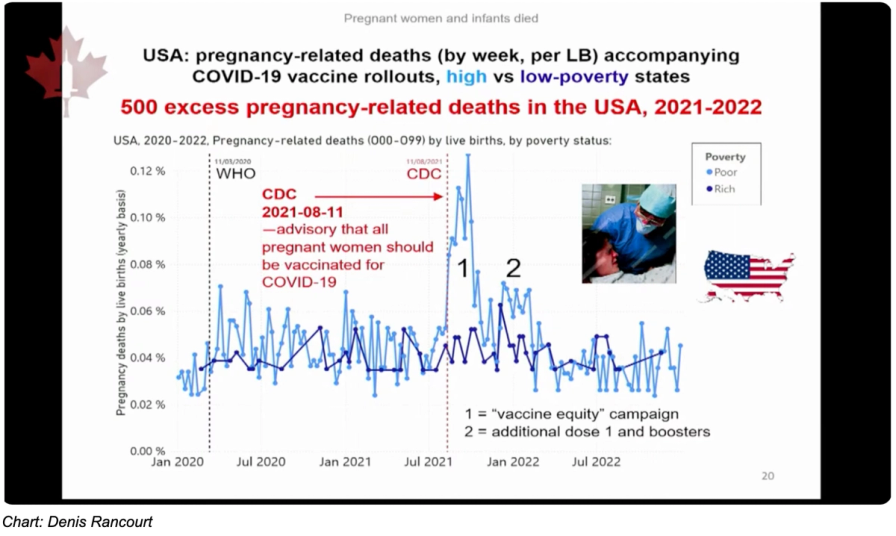
The numbers are impossible to ignore.
The injection did not stay in the arm
The public message was simple: the injection went into the muscle, delivered its instructions and was then rapidly broken down. But human research has shown that vaccine-associated mRNA can enter the bloodstream and remain detectable far beyond the injection site.
A 2022 human study detected Pfizer-BioNTech vaccine-associated synthetic mRNA in blood 15 days after vaccination.
A 2024 human study also detected vaccine mRNA and its associated lipid in blood up to 14–15 days after a Moderna booster.
But the most striking evidence is newer. In a 2026 peer-reviewed case report, researchers including Dr. Peter McCullough and Nicolas Hulscher reported detecting S1 spike protein in blood more than three years after a man's final Pfizer dose, along with vaccine-derived spike mRNA more than 3.5 years after vaccination.
The finding raises important questions about persistence and where vaccine-related material may travel in the body. And that brings us back to the reproductive system.The maternal bloodstream, placenta and fetus are biologically connected. If vaccine-derived material can circulate beyond the injection site, where else can it go?
The placenta and reproductive tissues
Researchers reported evidence of vaccine mRNA in placental tissue, maternal blood and cord blood following vaccination. The 2024 study, published in the American Journal of Obstetrics & Gynecology, identified sequences corresponding to Moderna’s mRNA-1273 and Pfizer-BioNTech’s BNT162b2 and described findings consistent with transplacental transmission.
A 2026 study published in PLOS One examined 106 placentas and found spike-positive cells in 31. Two samples contained vaccine-specific mRNA detectable by RNAscope, one associated with Pfizer’s BNT162b2 and another with Moderna’s mRNA-1273.
These injections introduced genetic material into the body
The COVID-19 injections represented a fundamentally different technology from conventional vaccines. Pfizer-BioNTech and Moderna used synthetic, chemically modified RNA to deliver genetic instructions into human cells, directing those cells to produce the SARS-CoV-2 spike protein.
The FDA explicitly describes the Pfizer-BioNTech product as containing mRNA, “which is genetic material,” that instructs cells to make the virus’s spike protein.
Health Canada likewise describes the Pfizer product’s nucleoside-modified mRNA as the “genetic code” that provides the blueprint for cells to make the spike protein.
The issue is not whether the injection permanently altered a person’s DNA. The issue is that genetic material was deliberately introduced into human cells to change what those cells produced.
Women deserved to understand that distinction before they were told to use the technology during pregnancy.
And when the technology is administered before conception, during pregnancy or throughout a woman’s reproductive years, questions about biodistribution, persistence, placental transfer, fetal exposure and reproductive effects are not minor questions.
They are the questions.
Reproductive signals emerged across multiple studies
The reproductive-health concerns did not come from one database.
A 2024 systematic review and meta-analysis covering 11 studies and 26,283 women found menstrual changes including abnormal cycle duration, dysmenorrhea (painful cramps), irregular cycles and abnormal menstrual flow.
A separate Norwegian registry study involving 666,467 women ages 20 to 40 found increased risks for several menstrual bleeding disturbances following vaccination, although some associations were reduced in self-controlled analyses.
A 2025 nationwide Czech study examining approximately 1.3 million women ages 18 to 39 reported lower successful conception rates among women vaccinated before conception beginning in June 2021. The authors described the findings as preliminary and hypothesis-generating.
Taken together, these findings point to a reproductive-health signal that warrants far more scrutiny than it has received.
Ovarian health cannot be treated as a footnote
A 2025 study in female rats receiving a human-equivalent mRNA vaccine regimen reported a greater than 60% reduction in primordial ovarian follicles in the mRNA group compared with controls, along with reduced AMH and changes associated with follicular atresia.
Rats are not women, and the finding cannot be translated directly into a human fertility rate.
But ovarian reserve is not a trivial endpoint.
And the concern is not limited to animal research.
At the September 2026 Allison Inquiry in Canada, researcher Deanna McLeod presented evidence concerning the distribution of Pfizer’s lipid nanoparticles and reproductive tissues, including the ovaries, alongside Ontario health-data findings involving female reproductive health and pregnancy loss.
The findings demand scrutiny.
When a technology is administered to millions of women of reproductive age, what happens in the ovaries is not a minor issue.
The Thorp signal
Dr. James Thorp, an obstetrician-gynecologist with 47 years of experience in maternal-fetal medicine, analyzed CDC/FDA VAERS data in his 2023 paper published in the Journal of American Physicians and Surgeons.
Thorp’s analysis of pregnancy-related adverse-event reports reported elevated reporting ratios for abnormal menstruation, miscarriage, fetal malformation, fetal cardiac disorders, fetal growth abnormalities, preeclampsia, premature rupture of membranes, preterm delivery and stillbirth.
The reported per-person relative risks included 15-fold for miscarriage, 15-fold for fetal malformation, 12-fold for fetal cardiac disorders and 9.5-fold for stillbirth, among other findings.
But Thorp’s subsequent work continued to identify signals. In a 2025 peer-reviewed analysis using CDC and FDA VAERS data, Thorp and colleagues examined 37 pregnancy and newborn adverse events and found that all 37 exceeded statistical safety-signal thresholds. The analysis included miscarriage, fetal malformations, placental disorders, fetal growth restriction, premature delivery, stillbirth and newborn death. For miscarriage, the reporting ratio was 114 compared with influenza vaccination and 38.4 compared with all other vaccines.
The signals demanded investigation.
Dr. Kimberly Biss watched miscarriage rates climb
Data systems tell only part of the story. Doctors see what happens in their practices.
Dr. Kimberly Biss, an obstetrician-gynecologist who has practiced since 1998, reported a dramatic increase in miscarriages in her private practice following the COVID-19 injection rollout.
She reported a miscarriage rate of approximately 4% in 2020, 8% in 2021, 15%–16% in 2022 and approximately 30% in early 2023.
Biss also reported increases in hypertensive disorders of pregnancy, preeclampsia, severe postpartum hemorrhage and blood transfusions.
“And then in early 2023, my miscarriage rate was 30% and I’ve never seen those numbers ever before in my years of practice which began in 1998.”
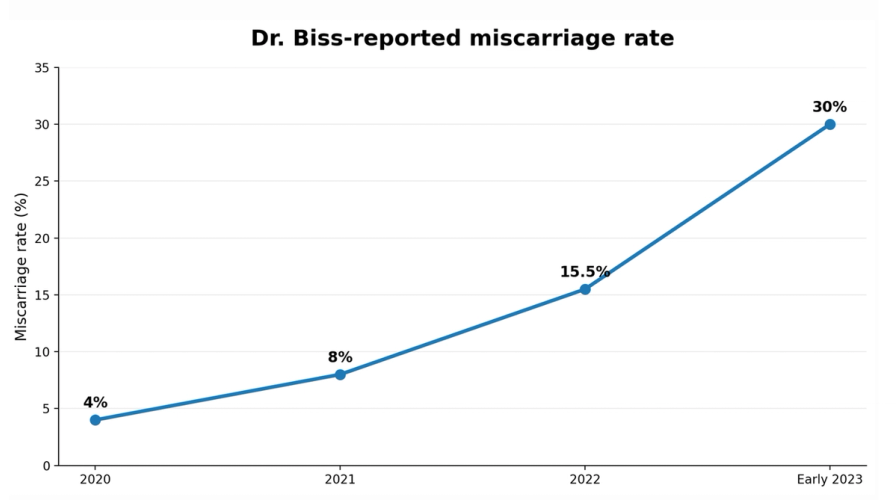
When an experienced OB-GYN reports a change that she had never seen before in decades of practice, the appropriate scientific response is not ridicule.
It is an investigation.
Infant mortality cannot simply be ignored
The stakes become even higher when the question moves from pregnancy complications to infant deaths.
Also at the Allison Inquiry on Sept. 8, 2026, Denis Rancourt identified a reversal in the long-running decline in U.S. infant mortality beginning in 2022, approximately nine months after COVID-19 vaccination was recommended for pregnant women.
His analysis estimated approximately 4,000 excess infant deaths in the United States from 2022 through 2024. He also estimated more than 2,000 excess deaths among U.S. children ages 1–4 between 2021 and 2024.
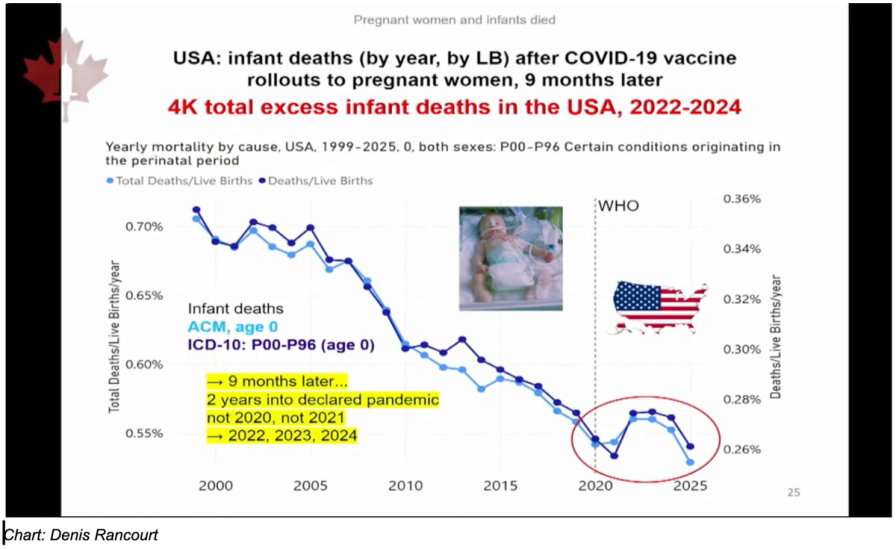
Infant mortality had been declining. Then the trend changed.
A major change in infant mortality following a major change in maternal medical exposure is precisely the kind of population-level signal that should trigger urgent, independent investigation.
Infants cannot tell us what happened to them.
That makes independent surveillance—and accountability—even more important.
Reproductive-health reports continued to accumulate
The broader reporting systems also contain a large volume of reproductive-health reports.
As of July 31, 2026, OpenVAERS listed more than 5,200 reports involving miscarriage or stillbirth, 38,000 menstrual-disorder reports, 13,000 reports involving vaginal or uterine hemorrhage, more than 13,500 reports involving cesarean delivery, preterm labor, premature birth or other birth difficulties, and more than 1,100 reports involving fetal defects, cardiac issues or fetal disorders.
When reproductive-health reports accumulate across multiple systems and are accompanied by signals in peer-reviewed studies, physician observations and population mortality data, the appropriate response is investigation—not dismissal.
When fertility, pregnancy, the placenta, fetal development and infant health are all showing signals, we have to ask a bigger question: Are we protecting women’s fundamental right to reproduce?
The questions do not end with pregnancy
There are additional questions surrounding the composition of the products themselves.
A 2025 peer-reviewed study by David Speicher, Jessica Rose and Kevin McKernan examined Pfizer-BioNTech and Moderna vaccine vials obtained in Ontario and reported residual plasmid DNA, including sequences associated with the SV40 promoter-enhancer-ori in Pfizer samples.
The findings have generated scientific controversy and require independent replication and confirmation.
But again, the fundamental question is straightforward:
What exactly was in the products people were being injected with, and were all relevant components adequately disclosed and investigated?
Canadian physician and researcher Dr. William Makis has also documented individual cases of rapidly progressive cancers that he and others have described as “turbo cancers,” including lymphomas, glioblastomas, triple-negative breast cancers and other aggressive malignancies.
In a 2023 interview, Makis said he had diagnosed approximately 20,000 cancer patients during his career and had never seen cancers behave this way.
He described stage 4 breast cancers in women in their 20s and 30s, stage 4 colon cancers in people in their 20s and 30s, rapidly fatal leukemias and lymphomas, and a case involving a 12-year-old boy who, according to Makis, developed stage 4 brain cancer four months after receiving a Moderna injection and died six months later.
Women deserved the truth
For years, women were told that they could trust the recommendations being given to them about their reproductive health. But the record raises a much more fundamental question: Were women given enough information to make truly informed decisions about COVID-19 injections before and during pregnancy?
The evidence presented here spans FDA records, Pfizer's own postmarketing reports, federal health officials' private communications, peer-reviewed studies, pregnancy and fertility research, physician experience and mortality data. Taken together, these records demand more than reassurance. They demand transparency, independent investigation and accountability.
And reproductive health is bigger than COVID-19 injections.
Women are exposed to an increasingly complex mixture of pharmaceuticals, pesticides, plastics and other environmental chemicals throughout their reproductive years. Yet the effects of these exposures on fertility, pregnancy and the developing baby are too often studied separately, regulated in isolation or addressed only after harm has already occurred.
If we are serious about protecting the next generation, we have to start looking at the whole picture. And that is where this series goes next.
Take Action
Moms Across America is working to uncover the science, test what is in our food and environment, share data, and demand policies that put the health of mothers and children first.
Your recurring support makes our work possible—we can’t do it without you!
- Become a monthly Moms Across America supporter today.
- Add your name to the COVID Justice Resolution, which calls for accountability and a full reckoning with the policies and harms of the COVID-19 era.
- Contact your House and Senate reps and urge them to support these bills: H.R. 9672 Vaccine Injury Compensation Modernization Act of 2026 H.R. 4668 End the Vaccine Carveout ActS. 3853 (IS) End the Vaccine Carveout Act
- Join and support the Moms Across America Movement (Yes MAAM!) so we can get to Washington and bring this information into the rooms where decisions are being made.
“50% more of our babies are dying because of Pharma, Fauci, our government, and the media’s lies.
The COVID jab is not only giving our loved ones turbo cancer, heart attacks, strokes, autoimmune and neurological disorders, it is preventing our precious babies from being born. This is infanticide. The destruction of the future of our country.
The COVID shots must be removed from the market immediately.”
-- Zen Honeycutt
Sources:
- U.S. Food and Drug Administration, Pfizer-BioNTech COVID-19 Vaccine Emergency Use Authorization Review, Dec. 10, 2020, U.S. FDA.
- Pfizer, Pfizer and BioNTech Commence Global Clinical Trial to Evaluate COVID-19 Vaccine in Pregnant Women, Feb. 18, 2021, Pfizer and BioNTech.
- New England Journal of Medicine, Preliminary Findings of mRNA Covid-19 Vaccine Safety in Pregnant Persons, April 21, 2021,Tom T. Shimabukuro, Sara Y. Kim, David K. Myers, Pedro L. Moro, Titilope Oduyebo, Lakshmi Panagiotakopoulos, Paige L. Marquez, Christine K. Olson, Ruiling Liu, Karen T. Chang, Sascha R. Ellington, Veronica K. Burkel, Ashley N. Smoots, Caitlin J. Green, Charles Licata, Bicheng C. Zhang, Meghna Alimchandani, Adamma Mba-Jonas, Stacey W. Martin, Julianne M. Gee and Dana M. Meaney-Delman.
- Research Square, Receipt of mRNA COVID-19 vaccines preconception and during pregnancy and risk of self-reported spontaneous abortions, CDC v-safe COVID-19 Vaccine Pregnancy Registry 2020–21, Aug. 9, 2021, Lauren Head Zauche, Bailey Wallace, Ashley N. Smoots, Christine K. Olson, Titilope Oduyebo, Shin Y. Kim, Emily E. Peterson, Jun Ju, Jennifer Beauregard, Allen J. Wilcox, Charles E. Rose, Dana Meaney-Delman and Sascha R. Ellington.
- Children’s Health Defense, CDC Recommends Pregnant Women Get COVID-19 Vaccine Based on Unverifiable Data, Aug. 24, 2021, Brian Hooker, Ph.D. and Eileen Iorio.
- Reuters, CDC recommends pregnant women get COVID-19 vaccine, Aug. 11, 2021, Reuters.
- U.S. Senate, Senators Johnson, Paul Release Additional Texts from Dr. Fauci’s Government iPhone, Aug. 16, 2026, Ron Johnson and Rand Paul.
- DailyClout, Women Have Three Times the Risk of Adverse Events Than Men; Risk to the Reproductive Organs Is Even Greater — Report 38, 2026, Naomi Wolf and DailyClout Pfizer Documents Analysts.
- DailyClout, Internal Report 25: 23% of Vaccinated Mothers’ Fetuses or Neonates Died; Suppressed Lactation and Breast Milk Discoloration Reported, Aug. 3, 2026, Naomi Wolf and DailyClout Pfizer Documents Analysts.
- DailyClout, Internal Report 15: “Pfizer and FDA Knew in Early 2021 That Pfizer mRNA COVID “Vaccine” Caused Dire Fetal and Infant Risks, Including Death. They Began an Aggressive Campaign to Vaccinate Pregnant Women Anyway.”, Aug. 3, 2026, Amy Kelly.
- WarRoom Books/Skyhorse Publishing, The Pfizer Papers: Pfizer’s Crimes Against Humanity, 2024, edited by Naomi Wolf and Amy Kelly.
- Denis Rancourt, Denis G. Rancourt expert-witness presentation slides to the Allison Inquiry – Pregnancy, infant, toddler and accelerated cancer excess mortalities, Sept. 8, 2026.
- American Journal of Obstetrics & Gynecology, Transplacental transmission of the COVID-19 vaccine messenger RNA: evidence from placental, maternal, and cord blood analyses postvaccination, 2024, Xinhua Lin, Bishoy Botros, Monica Hanna, Ellen Gurzenda, Claudia Manzano De Mejia, Martin Chavez and Nazeeh Hanna.
- PLOS One, Detection of spike protein in term placentas of COVID-19 vaccinated and/or SARS-CoV-2 infected women, March 5, 2026, Claudia Bartmann et al.
- BMC Women’s Health, Prevalence of menstrual alterations following COVID-19 vaccination: systematic review and meta-analysis, 2024, Abeer Al Shahrani et al.
- European Journal of Epidemiology, Covid-19 vaccination and menstrual bleeding disturbances among women of fertile age: a Norwegian registry study, 2024, Maria C. Magnus, Ida H. Caspersen, Knut-Arne Wensaas, Helena N. Eide, Anne K. Örtqvist, Laura Oakley, Per Magnus and Siri E. Håberg.
- International Journal of Risk & Safety in Medicine, Rates of successful conceptions according to COVID-19 vaccination status: Data from the Czech Republic, June 19, 2025, Vibeke Manniche, Tomáš Fürst, Max Schmeling, Jonathan D. Gilthorpe and Peter Riis Hansen.
- Vaccines, Impact of mRNA and Inactivated COVID-19 Vaccines on Ovarian Reserve, March 24, 2025, Enes Karaman, Adem Yavuz, Erol Karakas, Esra Balcioglu, Busra Karaca, Hande Nur Doganay, Koray Gorkem Sacinti and Orhan Yildiz.
- Journal of American Physicians and Surgeons, COVID-19 Vaccines: The Impact on Pregnancy Outcomes and Menstrual Function, 2023, James A. Thorp, Claire Rogers, Michael P. Deskevich, Stewart Tankersley, Albert Benavides, Megan D. Redshaw and Peter A. McCullough.
- Science, Public Health Policy and the Law, Are COVID-19 Vaccines in Pregnancy as Safe and Effective as the Medical Industrial Complex Claims? Part I, Feb. 8, 2025, James A. Thorp, Albert Benavides, Maggie M. Thorp, Daniel C. McDyer, Kimberly O. Biss, Julie A. Threet and Peter A. McCullough.
- Biomedicines, Vaccine mRNA Can Be Detected in Blood at 15 Days Post-Vaccination, June 28, 2022, Tudor Emanuel Fertig et al.
- ACS Nano, Blood Distribution of SARS-CoV-2 Lipid Nanoparticle mRNA Vaccine in Humans, Oct. 1, 2024, Stephen J. Kent et al.
- U.S. Food and Drug Administration, Examining Our COVID-19 Response: An Update from Federal Officials, March 18, 2021.
- Health Canada, Components of COVID-19 Vaccines, 2021.
- Medical Research Archives, Persistence of Vaccine mRNA, Plasmid DNA, Spike Protein, and Genomic Dysregulation Over 3.5 Years Post-COVID-19 mRNA Vaccination, June 30, 2026, Nicolas Hulscher, Vanessa Schmidt, Michael Morz, Claire Rogers, Natalia von Ranke, Wei Zhang, John A. Catanzaro and Peter A. McCullough.
- Independent Medical Alliance, IMA Fellow Dr. Kimberly Biss Reveals What Happened to Miscarriage Rates in Her Medical Practice During COVID, 2026, Kimberly Biss, M.D.
- Autoimmunity, Quantification of residual plasmid DNA and SV40 promoter-enhancer sequences in Pfizer/BioNTech and Moderna modRNA COVID-19 vaccines from Ontario, Canada, Dec. 2025, David J. Speicher, Jessica Rose and Kevin McKernan.
- Allison Inquiry, BURIED TRIAL DATA: Researcher exposes post-rollout health trends at Allison Inquiry, Sept. 2026, Allison Inquiry, Deanna McLeod.
- Children’s Health Defense, Mortality Data Reveal “Screaming Safety Signals” Following COVID Vaccine Rollout, Sept. 9, 2026, Brenda Baletti, Ph.D.
- OpenVAERS, COVID-19 Vaccine Reproductive Health Reports, July 31, 2026, OpenVAERS.
- William Makis, Turbo Cancer Evidence, 2026, William Makis.
- Rumble, Must Watch! Dr. William Makis on Turbo Cancer: “I’ve Never Seen Cancers Behaving Like This!”, 2023, William Makis.
- COVID Justice, COVID Justice Resolution, 2026, COVID Justice and collaborating organizations.