
 ®
®
There are certain questions that persist at the edges of public discourse, too complicated to fully explore and too intriguing to outright dismiss.
Since the 1970s, Lyme disease has been recognized as a widespread and mysterious tick-borne illness. The prevailing scientific consensus is that it emerged naturally, but layered beneath that consensus is a quiet and more complex situation that, for some, raises the question: “Was this pathogen manmade?”
The idea that Lyme disease could be connected, directly or indirectly, to government research did not emerge in a vacuum. It is rooted in a series of observations that, while likely coincidental, have raised eyebrows for decades. For instance, the first mainstream outbreak of Lyme disease occurred less than ten miles from a U.S. government animal disease research facility. Declassified records have also since revealed that during the same time period, the U.S. military was actively researching unconventional methods of warfare, including vector-based disease transmission.
And after decades of speculation, questions surrounding the origins of Lyme are beginning to resurface. This renewed scrutiny is being fueled by a swirl of internet rumors about farmers finding boxes of ticks in their fields, viral videos of “killer ticks” running for and swarming host animals, rising cases of a tick-borne red meat allergy called Alpha-gal syndrome, and the announcement of a new Lyme vaccine. Against a modern backdrop of rising distrust in institutions, the expansion of GMO insect programs, and a 2026 congressional mandate to investigate whether the U.S. military ever experimented with weaponized ticks, these threads begin to converge, raising a broader and pressing question: How much do we actually know about the intersection of insects, genetic modification, and disease?
Investigating the origins of Lyme disease requires more than examining a pathogen. It requires examining the historical, biological, and environmental conditions under which it emerged.
And that is where this inquiry begins.
The Ecology of Borrelia
Lyme disease is primarily transmitted through the bite of infected blacklegged ticks carrying Borrelia bacteria, a family of closely related spirochetes. In the United States, the main causative species is Borrelia burgdorferi sensu stricto, though others, like Borrelia mayonii and Borrelia miyamotoi can cause similar symptoms. In Europe and Asia, Borrelia afzelii and Borrelia garinii are common causes of other Lyme-like illnesses.
The presence of multiple disease-causing Borrelia species across different regions supports the view that these bacteria evolved naturally over time, adapting to local environments, hosts, and ecological conditions. Genetic and phylogenetic analysis, including studies of preserved specimens, further suggest that these bacteria predate the 20th century and evolved via unaltered processes.
This evidence forms the basis of the current scientific consensus that Lyme disease is naturally occurring. Yet the illness itself remains clinically complex. Symptoms can vary widely, overlap with other conditions, and change over time, making diagnosis difficult. Fewer than half of patients recall a tick bite or develop the characteristic “bulls eye” rash, and diagnostic testing often relies on detecting immune response rather than the bacteria directly. While treatment is straightforward for some, others experience persistent long-term symptoms.
The biology and ecology of Borrelia help explain the organism itself, but not fully why Lyme disease emerged when and where it did.
Where It Began: A Series of Coincidence
A key factor in the emergence of Lyme disease was the evolving relationship between humans and the environment. In the Northeastern United States, Lyme appeared at a time of reforestation, rising deer populations, and expanding suburban development. These shifts brought humans into closer contact with tick habitats.
It was under these conditions that Lyme disease was first identified in the mid-1970s in Lyme, Connecticut, where an unusual cluster of juvenile arthritis cases prompted an epidemiological investigation. This led researchers to uncover what would later be identified as a tick-borne bacterial infection. By the early 1980s, the primary causative bacteria had been isolated and the modern understanding of Lyme disease began to take shape.
But for many, that story has never felt complete.
Part of the tension is tied to place and time. Lyme, Connecticut is less than ten miles from the Plum Island Animal Disease Center, a U.S. government facility off the coast of Long Island that is dedicated to the study of animal-borne disease. Lyme also emerged during the height of Cold War biological research, a period defined by both scientific advancement and military secrecy. These details, though not evidence of Lyme disease being deliberately engineered, have lingered in the background, quietly fueling suspicion for decades.
And while much about the disease itself remains mysterious, the historical record surrounding Cold War research is far more concrete.
The Declassified Military Documents
Was Lyme simply the natural emergence of an ancient pathogen shaped by human encroachment into wooded environments? Or could it be connected, in some way, to a lesser-known chapter of U.S. military and intelligence history? The records that have so far been made public do not provide a direct answer to that question. But they do establish several key facts:
- First, that the United States maintained an active biological weapons program for decades.
- Second, that these programs extended beyond the study of pathogens themselves to include methods of covert transmission.
- And third, that insects were studied as potential vectors of disease transmission.
During the mid-20th century, the United States was actively engaged in biological warfare research as part of Cold War strategy. These programs were centered at facilities including the Plum Island Animal Disease Center and Fort Detrick in Frederick, Maryland. The scope of this research extended beyond pathogens themselves to include how they could be introduced into populations and environments.
Declassified documents associated with Operation Mongoose reveal a broad willingness to pursue unconventional forms of societal disruption. Planning materials from the program describe coordinated efforts involving “political, psychological, military, sabotage, and intelligence operations” alongside actions designed to destabilize infrastructure and social systems within Cuba.
Other declassified records from this period show that dissemination was a central concern. Programs such as Project 112 were “primarily concerned [with] the use of aerosols to disseminate biological and chemical agents,” reflecting an active effort to understand how such materials could be deployed in the real world.
Among the more unconventional strategies explored was the use of insects as vectors of disease transmission. Other declassified materials associated with Project 112 reference the feasibility of an offshore release of Aedes aegypti mosquitoes as a vector for infectious diseases, indicating that vector-based transmission was not merely theoretical, but actively studied as a potential delivery mechanism.
These records do not demonstrate that Lyme disease itself was engineered or deployed. But they do establish something important: the concept of manipulating biological systems, including the use of arthropod vectors to transmit disease, was studied and taken seriously within U.S. military and intelligence communities. And more than half a century later, questions about the scope and implications of that research have not fully disappeared.
In December 2025, Congress approved an amendment to the FY2026 National Defense Authorization Act directing the Government Accountability Office (GAO) to investigate whether the U.S. military experimented with or weaponized ticks carrying Lyme disease between 1945 and 1972. That same month, the U.S. Department of Health and Human Services convened a national Lyme disease roundtable in Washington, bringing together patients, clinicians, researchers, and federal officials to address ongoing gaps in Lyme diagnosis, treatment, and understanding.
These recent developments suggest that questions surrounding Lyme disease are no longer confined to casual speculation. They are being revisited, formally, at the highest levels of government.
And at the same time, the trajectory of this research did not end with the Cold War. What was once explored in classified programs has, in some cases, transitioned into open scientific research and commercial application. The tools have changed, the language has evolved, and the intent is often framed differently but the underlying concept remains: using living organisms to influence the spread of disease.
From Research to Reality: Modern Insect-Based Biotech
In recent years, biotechnology has expanded to include what is known as gain-of-function research, in which the virulence of a pathogen is enhanced in order to better understand how it evolves, spreads, and interacts with hosts. While distinct from earlier biological weapons programs, this modern field of research is at the center of an ongoing debate about the boundaries of ethical research and reasonable risk.
Public concern over these risks is not without precedent. In 2014, following widespread alarm within the scientific community and beyond, the U.S. government implemented a temporary pause on certain gain-of-function research involving influenza, SARS, and MERS viruses. More recently, the COVID-19 pandemic has intensified scrutiny, with ongoing debate about the origins of the virus and whether certain lines of research may have carried unintended consequences. While definitive conclusions remain contested, the conversation itself has highlighted a growing unease about how far such research has gone, and under what oversight.
Scientific advances have also moved beyond altering pathogens to also directly modifying the organisms that carry them. Genetically modified insects are now being developed and deployed in the real world, often framed as tools for public health and disease mitigation. Funded through a combination of taxpayer dollars, academic research, and private biotechnology companies, this work reflects a hybrid model where public health goals and commercial interests intersect.
One of the most widely known examples comes from Oxitec, a biotechnology company that genetically modifies mosquitoes to reduce wild populations that carry diseases like dengue and Zika. These insects are engineered with a self-limiting gene that prevents offspring from surviving to adulthood. Field trials and releases have taken place in countries including Brazil, the Cayman Islands, and the United States, including pilot programs in Florida and California. In the Florida Keys alone, millions of GMO mosquitoes have already been released, with federal approval allowing for up to a billion over a two-year period. In California, plans have gone even further, with authorization for up to 2.4 billion mosquitoes across multiple counties, though implementation has faced resistance.
Alongside these self-limiting technologies, more advanced insect gene modification approaches are advancing. One of the most significant is gene drive technology, which is being explored by international initiatives like Target Malaria. Gene drives are designed to spread specific genetic traits through entire populations over time, meaning the changes will persist and proliferate rather than disappear after a few generations, as is the case with self-limiting approaches. Underlying many of these developments is Clustered Regularly Interspaced Short Palindromic Repeats, or CRISPR. CRISPR is a revolutionary gene-editing tool that allows scientists to make precise changes to DNA. Its use extends beyond insects to plants, animals, and even human cells, emphasizing the breadth of its potential and the scale of its implications.
The scope of this work is already continuing to expand beyond mosquitoes. Genetic approaches are now being applied to agricultural pests as well as insects that transmit diseases to animals, including those linked to bluetongue and Schmallenberg viruses. The goal is to reduce reliance on chemical pesticides and antibiotics while strengthening the resilience of global food systems. These efforts extend beyond human health and agriculture into broader ecosystem and livestock management strategies.
Here is a look at some of the current GMO insect programs going on throughout the world:
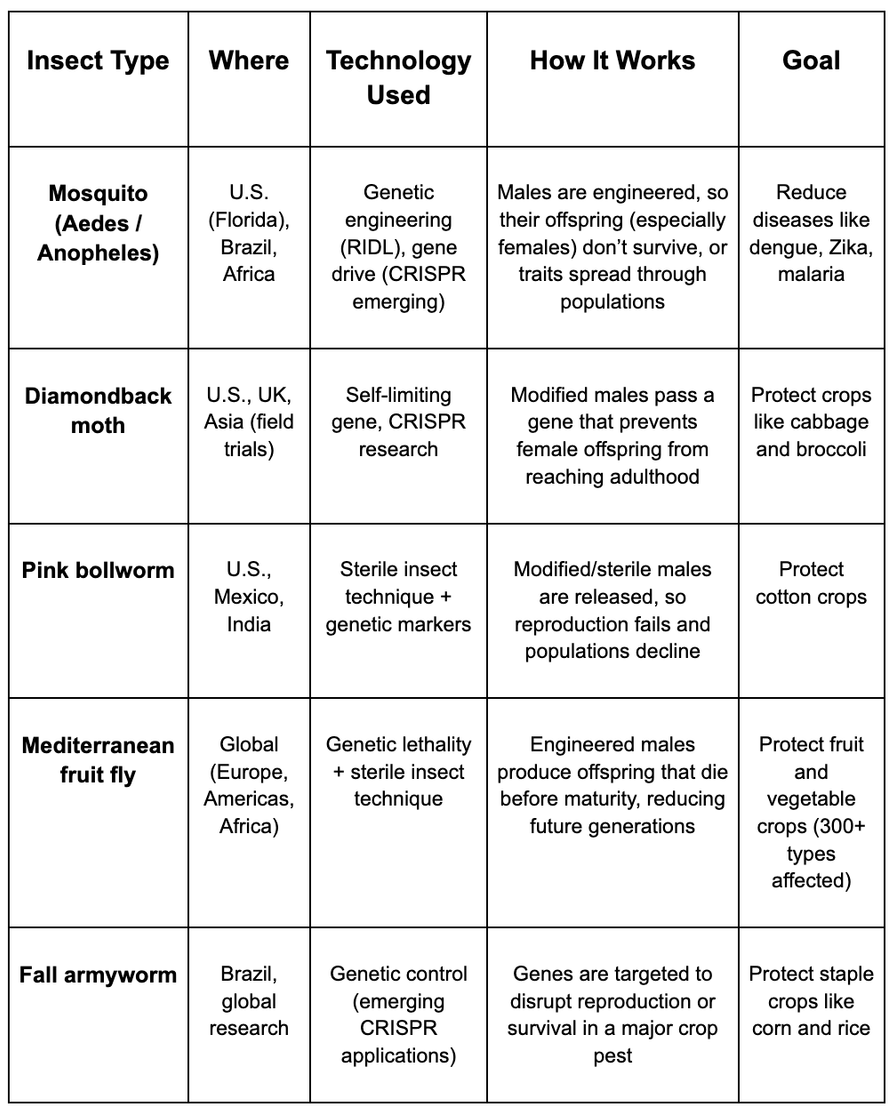
For some, these developments represent a promising frontier in disease control and agricultural management. For others, they raise deeper questions about ecological balance and the extent to which complex biological systems can be safely and predictably altered.
Not A Call To Fear - A Call To Action
So, is Lyme disease a bioweapon? The question is no longer whether such research has been considered, but how far it has already gone. Though no direct link between Lyme disease and bioweapons research has been officially confirmed, the overlap in timing, geography, and context continues to raise scrutiny. Even 50 years later, that tension refuses to disappear.
It also opens the door to a more broad conversation about the legitimate, well-founded ethical issues surrounding the historical and ongoing allowance of bioweapons-related research. These issues point to deeper challenges around transparency and regulation across both government institutions and the global scientific community.
We are living in a time when genetic manipulation is no longer theoretical or confined to classified research programs. It has moved into the commercial sphere, where for-profit ventures are actively developing and, in some cases, releasing these technologies into the environments around us.
This is where the conversation must shift.
When the fate of entire ecosystems hangs in the balance, our responsibility to demand accountability does not diminish. It deepens. A sustainable future will require thoughtful engagement, better questions, and a commitment to staying informed about the systems shaping our health and environment.
That can look like:
- Following the ongoing federal investigations, including updates from the Government Accountability Office on historical research into vector-based disease transmission.
- Staying informed through independent watchdog organizations that track genetic technologies, synthetic biology, and environmental impact. Groups like the ETC Group and Greenpeace help to translate complex developments into accessible, public-facing information.
- Engaging with the policy process shaping these technologies. Consider following and supporting organizations that work at the intersection of science and regulation, such as the Center for Science in the Public Interest and the Environmental Defense Fund, and consider submitting public comments on emerging biotech policies.
- Support transparency and accountability efforts at the grassroots level. Campaigns like the Stop Gene Drives Campaign are actively calling for caution, oversight, and broader public dialogue before irreversible changes are introduced into living ecosystems.
- And perhaps most importantly: Take appropriate measures to protect yourself and your family from ticks by using repellents, wearing protective clothing, checking for ticks after outdoor activity, and promptly seeking medical attention if symptoms arise.
Lyme disease may remain, in part, a mystery. But this story is not just about where we have been. It is about where we are going, and whether we are willing to fully understand the technologies we are shaping, before they begin to shape our world.