
 ™
™
Is Clean Drinking Water A Constitutional Right? Apparently Not.
On September 4, 2026, a federal appeals court ruled that residents of Jackson, Mississippi, could not invoke the U.S. Constitution to hold their government accountable, after officials allegedly allowed lead to contaminate their drinking water–and then assured them it was safe.
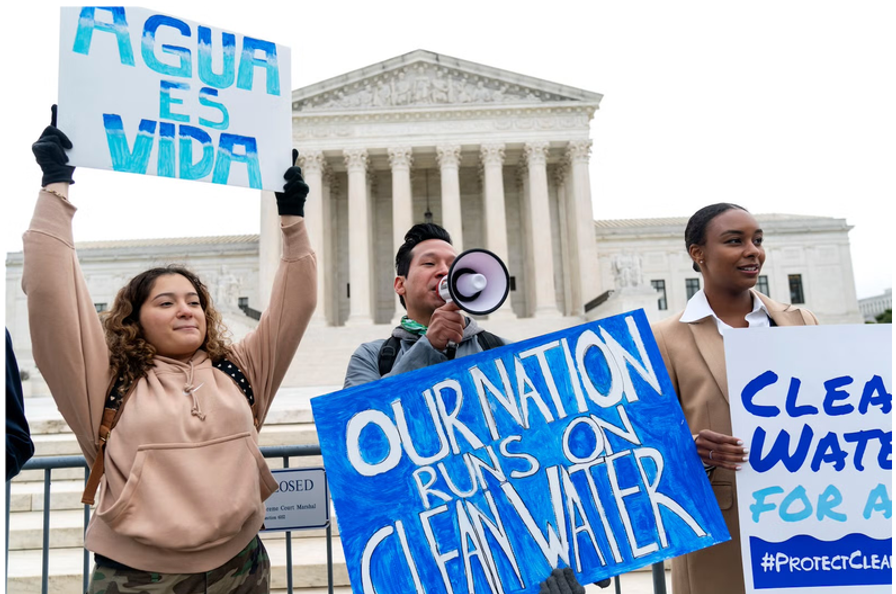
As we are watching global freshwater scarcity reach new levels of crisis, water-intensive infrastructure like data centers are claiming more and more. Water’s financial value is also rising, yet Americans have no federally recognized constitutional right to clean drinking water. That imbalance creates an ever-more urgent need for clear, enforceable laws recognizing that our natural resources are not expendable industrial inputs, but the foundation of human life.
If families cannot rely on a constitutional remedy even after their drinking water has been contaminated, how much worse will we allow the water crisis to become before we prioritize clean water and human life over private profit and industrial growth?
A Horrifying Conclusion
The case, Sterling v. City of Jackson, was brought by residents who alleged that city officials knew Jackson’s aging water system was vulnerable to lead contamination, but failed to correct the problem and made decisions which caused the situation to worsen. Even after tests indicated that the water could be dangerous, officials allegedly continued telling residents it was safe. Trusting those assurances, families drank it, cooked with it, and bathed their children in it.
The residents filed their class-action lawsuit in September 2022, shortly after the city’s water system partially collapsed and left more than 150,000 people without reliable running water. But the plaintiffs stressed that the disaster was not sudden. “This didn’t start a couple weeks ago. This started years ago,” lead plaintiff Priscilla Sterling told WAPT. Sterling, a longtime Jackson school teacher, alleged that several of her children had been diagnosed with lead poisoning.
Another plaintiff, Raine Becker, was working three jobs while caring for a seriously ill son who needed clean water for his feeding tube. “We’re suffering because of the lack of leadership and planning by government officials and others,” Becker said when the lawsuit was filed. The residents sought repairs to lead pipes and fixtures, safe water delivered to their homes, relief from paying for contaminated water, and compensation for the harm they alleged they had suffered.
The premise of the lawsuit was that knowingly supplying contaminated water and misleading people into consuming it goes beyond government negligence, violating the residents’ constitutional right to bodily integrity. A three-judge panel of the Fifth Circuit initially agreed that the allegations were sufficient for part of the lawsuit to proceed. After rehearing the case, however, the full Fifth Circuit reversed that decision.
In its September 4 ruling, the court stated plainly: “It is undisputed that the Constitution does not guarantee clean water.” It also ruled that exposure to lead-contaminated municipal water did not qualify as the kind of direct physical intrusion protected by the constitutional right to bodily integrity. The court even found no constitutional right to receive truthful information from public officials about contamination during a public health crisis.
While drinking water laws, environmental regulations, state constitutions, and other civil claims may still offer protections for our communities, this ruling nevertheless exposes a dangerous weakness in American law: clean water may be essential to life, but without explicit legislation protecting it, families cannot assume the Constitution will provide a remedy after their water has been contaminated.
Why This Ruling Matters Now
The Sterling ruling did not occur in a vacuum. It arrived as the systems delivering America’s drinking water are deteriorating and pressure on the nation’s freshwater supplies is growing. At the same time, water is becoming more valuable to private interests while the federal constitutional protections available to families remain uncertain.
America’s aging drinking water infrastructure makes this legal gap especially dangerous
The EPA acknowledges that the nation’s water infrastructure is “aging and in need of repair.” Its latest assessment estimates that drinking-water systems will require $625 billion in improvements over the next 20 years. Of that amount, $422.9 billion is needed to replace or rehabilitate aging and deteriorating pipelines. The agency also estimates that approximately four million lead service lines remain across the country.
As these systems deteriorate, the risk of service failures and contamination grows. The legal gap exposed by Sterling leaves families vulnerable to the consequences of infrastructure failures they did not create and may have little power to prevent.
The world is in a state of “global water bankruptcy”
Nearly three-quarters of the global population already lives in water-insecure countries. Many communities are withdrawing water from rivers and aquifers faster than those sources can be replenished, while pollution and ecological damage are making some losses irreversible. In January 2026, the United Nations University Institute for Water, Environment, and Health declared that the world had entered an era of “global water bankruptcy.”
Against this backdrop, the absence of a federally recognized constitutional right to clean water leaves communities dangerously exposed as access to this essential resource becomes less certain.
The United States is fast-tracking a historic water-dependent infrastructure buildout without comprehensive safeguards
A flurry of executive orders is accelerating the construction of enormous data centers across the country. Many facilities consume water directly for cooling, while the power plants generating their electricity can consume even more. Demand may be greatest during hot weather, when drought and residential use are already straining water and electrical systems.
Yet no comprehensive federal standards require privately owned data centers to disclose their resource consumption or undergo independent cumulative-impact reviews before development begins. The Federal Data Center Enhancement Act addresses resource efficiency at federal data centers, but it does not establish equivalent requirements for privately owned facilities and is scheduled to expire on September 30, 2026, unless Congress acts. Meanwhile, the Government Accountability Office reports that companies generally do not disclose detailed information about the energy and water consumed by generative AI.
Private interests can secure and profit from water claims that families do not have
Depending on the location, companies may acquire water rights or negotiate permits and agreements reserving substantial amounts of public water capacity. In Botetourt County, Virginia, for example, an agreement reserves up to two million gallons per day for a Google data center. Although such agreements may include drought restrictions, they can still provide corporations with legally enforceable access to water while families possess no equivalent federal constitutional guarantee.
Water scarcity is also generating new opportunities for financial institutions. In 2011, Citigroup chief economist Willem Buiter predicted that water would become “the single most important physical-commodity based asset class.” Nasdaq now tracks the price of California water rights, while the Chicago Mercantile Exchange offers futures contracts based on that index.
These contracts do not involve investors taking physical delivery of water, but the larger contrast is impossible to ignore: powerful institutions can secure contractual rights and financial opportunities tied to water, while ordinary Americans cannot rely on the Constitution to guarantee that the water entering their homes is safe.
Your ability to seek justice may depend on your ZIP code
Although the Fifth Circuit rejected the constitutional claims brought by Jackson residents, the Sixth Circuit previously allowed similar claims arising from the Flint and Benton Harbor water crises to proceed. As the Fifth Circuit acknowledged in its Sterling opinion, it was “not bound, nor persuaded” by the Sixth Circuit’s approach. Consequently, families alleging comparable government conduct may encounter substantially different federal remedies depending on where they live.
When access to safe water is essential to survival, such fundamental protections should not depend on which federal judicial circuit a family happens to call home.
At What Point Do We Protect People Over Industry?
As our natural resources continue to be depleted in service of industry, at what point does our government begin protecting the American people over the industries profiting from their destruction?
The Fifth Circuit ruling makes one thing painfully clear: communities cannot assume the Constitution will protect their water after it has been depleted or contaminated. These protections must be explicitly written into law and enforced before the damage occurs.
Yet the Federal Data Center Enhancement Act, the only federal statute specifically addressing resource efficiency at federal data centers, is set to expire on September 30, 2026. The law is limited and does not adequately protect communities from privately owned hyperscale facilities, but allowing even this framework to disappear without a comprehensive replacement would move the country in precisely the wrong direction.
Congress must extend the FDCEA until it passes clear, enforceable standards covering both federal and private data centers. When the Constitution does not guarantee clean drinking water, lawmakers have an even greater responsibility to protect it before it is contractually committed, depleted, or contaminated.
[Sign our letter urging Congress to extend the FDCEA before September 30.]
Please also consider donating to Moms Across America so we can continue investigating these issues, creating public resources, and advocating for healthier, better-protected communities.