
 ™
™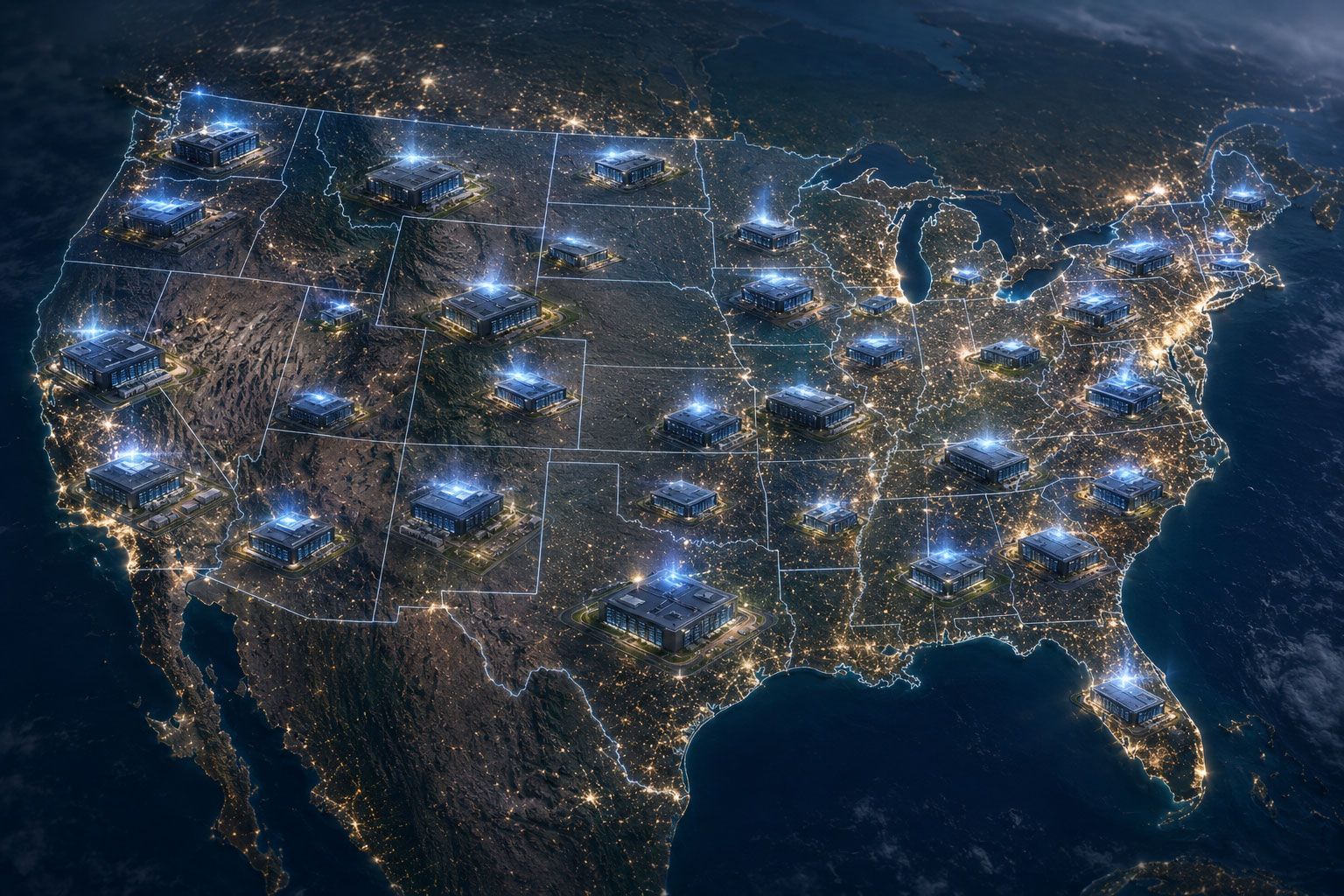
The United States is not losing the global data center race. We are lapping the field.
President Trump has made winning the global AI race official U.S. policy. But with pressure mounting on our natural resources and energy grids, organized public resistance growing stronger by the day, and more data centers than the next 14 highest-ranking countries combined, when, exactly, do you call the race, Mr. President?
Spoiler Alert: America Is Already Winning
In January 2025, President Trump turned the global race for technological supremacy into official federal policy. Executive Order 14179 declared that the United States would “sustain and enhance America’s global AI dominance.” Six months later, while unveiling America’s AI Action Plan, Trump put it even more bluntly: “America is the country that started the AI race. And as President of the United States, I’m here today to declare that America is going to win it.”
But if data centers are a measure of victory, America has already won. So why are we still racing?
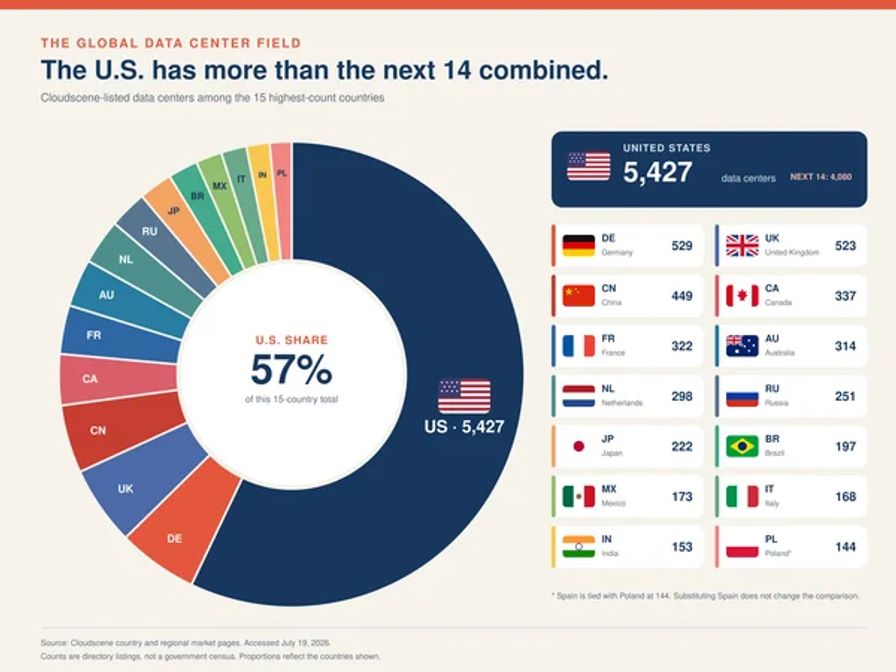
We are told that the United States must build bigger and faster or risk falling behind in artificial intelligence. But the actual numbers expose a contradiction. Cloudscene, a data center directory, currently lists 5,427 data centers in the United States, more than ten times the number in any other country and more than the next 14 highest-ranking countries combined. China, routinely cited as the nation that America must outrun, has just 449 in the same dataset.
Exact data center totals vary because there is no official global measure, and different industry databases count facilities differently. But the larger truth is not in dispute: no other country comes close to America’s existing data center footprint.
If this overwhelming lead does not count as winning, what would? And how much more land, water, electricity, money, and local decision making must American communities surrender before we reach a finish line that no one has bothered to define?
Build More, Regulate Less- And Hurry!
In July 2025 the White House orchestrated the “race” rhetoric into national strategy with America’s AI Action Plan. The document declares that the United States is in a “race to achieve global dominance” and argues that whichever nation builds the largest AI ecosystem will have the upper hand, reaping the greatest economic and national security rewards. One of its three central pillars is the rapid construction of data centers and the massive energy infrastructure needed to power them.
The message is unmistakable: Speed is national priority while regulations, permitting requirements, and environmental reviews are treated primarily as barriers to overcome.
The government has developed a coordinated federal strategy for accelerating data centers, without creating an equally comprehensive strategy for protecting the natural ecosystems and people who are expected to bear the consequences. The plan defines no clear finish line, resource ceiling, or point at which expansion becomes excessive.
Fun Fact: These Facilities Have No Protective Guardrails
The imbalanced “build more now, worry later” stance became official policy via Executive Order 14318. The order directs federal agencies to facilitate the “rapid and efficient buildout” of data centers by “easing Federal regulatory burdens.” For qualifying projects, including data centers requiring more than 100 megawatts of new electricity, it calls for expedited permitting, federal financial support, access to “suitable” federal lands, greater use of categorical exclusions from environmental review, and accelerated treatment under FAST-41. It also directs the EPA to develop guidance for speeding environmental reviews for putting data centers in Superfund and Brownfield sites. Putting enormous, resource-intensive facilities on dangerously contaminated land while simultaneously reducing environmental scrutiny and speeding up the review process: what could possibly go wrong?
Federal data center standards do exist, but their scope of reach is remarkably narrow. The Federal Data Center Enhancement Act is the only piece of federal legislation establishing data-center-specific minimum standards. It establishes requirements for energy, sustainability, and security, yet applies only to facilities that are owned, operated, or maintained by covered federal agencies and, where applicable, to facilities operated by contractors on their behalf. It does not regulate private facilities, which are driving the current construction boom. This act is also set to expire on September 30, 2026 with no clear extension, expansion, or replacement in place.
Exactly how much of the industry is private? No authoritative, apples-to-apples count exists. Federal inventories use definitions that are broad enough to include a room containing a single server, making them impossible to compare honestly with commercial directories. The best nationwide federal estimate is older and based on electricity consumption: A 2007 EPA report to Congress estimated that federal servers and data centers consumed approximately 10 percent of all U.S. data center electricity in 2006, leaving roughly 90 percent to private, non-federal facilities. That is not the same as saying 90 percent of data centers are privately owned, but this figure demonstrates how few data center facilities are actually reached by the regulations that do exist.
And the consequences of this classification ambiguity are no longer theoretical. In April 2026, the NAACP sued xAI and one of its subsidiaries, alleging that they installed and are operating dozens of methane-gas turbines to power the Colossus 2 data center near Memphis without the required Clean Air Act permits. The Justice Department moved to intervene and dismiss the case, arguing that the facility develops AI models that are “critical to the economy and the Department of War” and therefore the facility is a national security asset. There is not yet a ruling in this case, but it is clear which side the current administration is prepared to defend.
The Glaring Impacts Of The Buildout
Water is only the beginning. Data centers also consumed approximately 176 terawatt-hours of electricity in 2023, and Lawrence Berkeley National Laboratory’s latest reference case projects that they could account for 11.8 percent of the nation’s electricity use by 2030. Meeting that demand is inevitably requiring new power plants, substations, and transmission lines, which affects household rates and grid reliability.
Citing AI-driven electricity demand, the Department of Energy announced two funding packages on June 4, 2026, totaling up to $850 million: up to $350 million to build, modernize, and restart coal plants, and up to $500 million to support 13 additional coal plants and new export infrastructure. The DOE promoted the initiative as reviving “beautiful, clean coal,” despite coal’s well-documented harms to public health and the environment. Fossil fuel power plants, turbines, and backup generators also contribute to air pollution and climate emissions.
Data center cooling systems pressure municipal water supplies, treatment facilities, and groundwater levels. Campuses can span hundreds of acres, displacing farms, forests, and homes, while their operations produce heat and noise around the clock.
Nearby communities are facing overlapping health risks without baseline testing or health impact assessments. Many residents also report receiving little to no information before projects are being approved. The impacts vary from project to project. The absence of clear and enforceable standards for measuring, disclosing, and limiting these impacts does not.
Then there is the mysterious phenomena of local governments awarding exorbitant subsidies and tax abatements to potentially multi-billion dollar projects, oftentimes before the full public costs are even clear. The latest state and local figures indicate that data center tax exemptions and abatements are costing local governments in the United States more than $8 billion annually in foregone revenue. That is an acknowledged undercount because more than a dozen states offering these subsidies do not disclose their total costs.
A Race Without a Finish Line
We are in this data center race of a lifetime, yet the federal government has never defined what winning this race actually means. Is victory having the most facilities, the greatest computing capacity, the most powerful AI models, the largest corporate investment, or the strongest national security? At what measurable benchmark will we start to slow the expansion?
Raw facility counts do not determine AI leadership, but if the federal government is continually building data centers because they say it is necessary to win, they should be able to say how much infrastructure is required, what public benefit it must deliver, and what would constitute “enough.”
A race without a finish line can justify nearly anything. Every new facility becomes essential, every safeguard becomes an obstacle to progress, and every U.S. citizen that speaks up can be considered a domestic terrorist standing between America and its future.
Questioning unlimited expansion is not opposing technology. It is asking the government to consider necessity, efficiency, public benefit, and limits alongside speed and scale. America cannot navigate the race while refusing to say where the finish line is.
Who Is All Of This Even For?
The question is not whether AI has value. AI is useful in many facets of daily life and is advancing science and medicine, strengthening national security, and driving economic growth. But it is worth pointing out that private companies own the infrastructure and collect the profits, while host communities supply their land, water, energy, tax dollars, and environmental resources. The White House’s voluntary Ratepayer Protection Pledge recognizes the injustice of shifting infrastructure costs to households, but voluntary promises are not the same thing as clear and enforceable federal standards.
And, as we can see from the numbers, a country this far ahead of everyone else can surely afford to pause, measure, and establish some benchmarks.
Here are some ways you can help them get the message:
- Sign our letter to Congress. Urge your U.S. representative and senators to extend the Federal Data Center Enhancement Act (FDCEA) until Congress passes clear, enforceable standards covering both federal and private data centers.
- Sign our other action letters. Tell federal leaders that coal should not be revived to power the data center buildout, and urge President Trump to visit communities experiencing the impacts firsthand.
- Keep advocating locally. Until national protections exist, communities must continue pursuing moratoriums, bans, and enforceable local standards. Do not wait for Washington to act.
- Support this work. Donate to Moms Across America to help us continue investigating these issues, developing public resources, supporting communities, and advocating for meaningful protections.
- Join the MAA Data Center Action Team. We are actively seeking volunteers to research, organize, track legislation, connect with affected communities, and bring this work into more towns and states. Please email info@momsacrossamerica.org to get involved.