™
™
Prior to this part launch, part rant, and of course, weed whacking, I need to give credit to my podcast producer, Anne Temple. We were prepping for the next podcast and she mentioned that in her neck of the woods, the air was horrific from the Canadian fires. She asked what happens to glyphosate when it burns?
I thought I knew all things glyphosate, but I was stumped. I wasn’t sure, so I had to dig my way through the weeds and jump in the rabbit hole.
This article is dedicated to all the wonderful Canadians I've had the pleasure to get to know through the most unfortunate circumstances, including those brilliant minds behind the development of the National Citizens Inquiry.
Here goes…
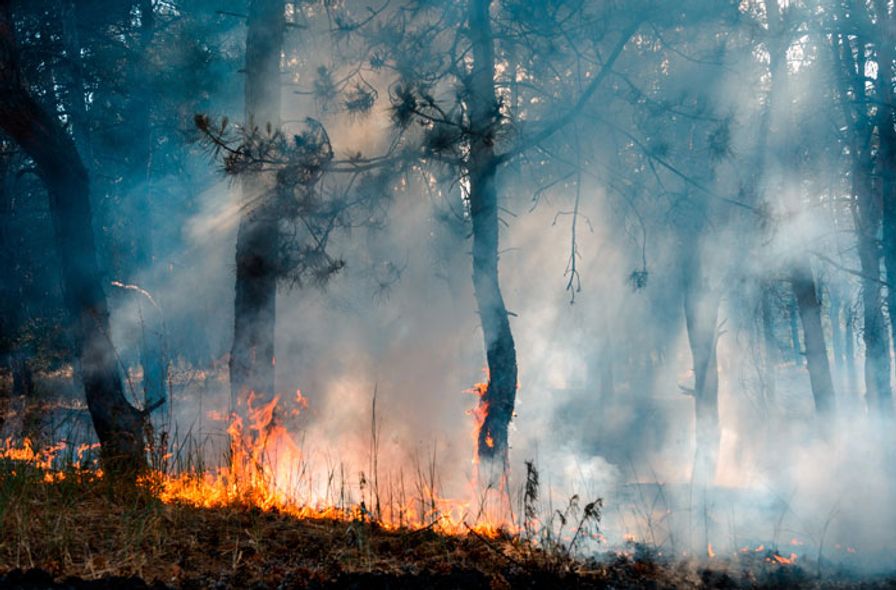
It is July 2026. Over 900 active wildfires are burning in Canada across Ontario, Manitoba, and beyond while blazes in Minnesota's Boundary Waters have crossed the border in both directions. Smoke has engulfed the Washington Monument and the Lincoln Memorial in an orange-gray haze. Detroit, Chicago, and Minneapolis have registered some of the worst air quality on the planet. Major League Baseball postponed games. The Soap Box Derby canceled events. The President is threatening tariffs. Millions of Americans from the Midwest to the Mid-Atlantic are checking air quality apps, sealing windows, and pulling N95 masks from drawers that hadn’t been opened since the pandemic.
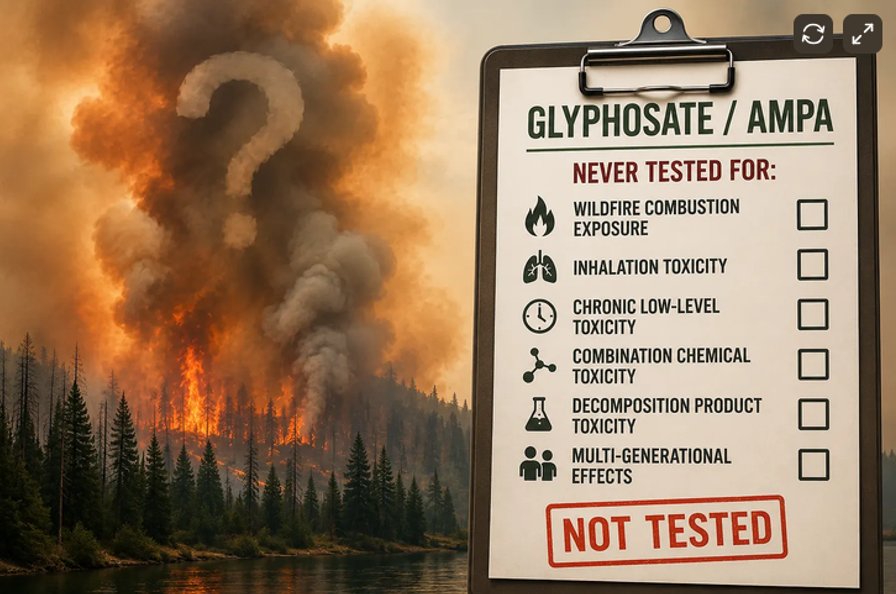
The models generating those air quality readings track one variable: PM₂.₅ mass per cubic meter of air. They do not ask what is on the particulate. They do not model what happens when millions of hectares of glyphosate-sprayed forest burn, and the smoke crosses a continent.
No regulator in North America has ever asked that question. Not because it’s unanswerable. Because nobody has been required to.
The Scale of the Spraying
Canada does not track its own glyphosate use federally. No national database exists. What we know comes from patchy provincial data, often extracted through freedom of information requests.
Sapinski & Surette (2023) paper on New Brunswick confirms: In Canada, no jurisdiction — federal or provincial — monitors glyphosate presence in the environment or in human populations. The only testing done is by the Canadian Food Inspection Agency who monitors levels of glyphosate residues in food.
New Brunswick: Forestry accounts for 61% of all glyphosate use. Eighty-three percent is applied by helicopter. Roughly 0.5% of forested land is sprayed annually which may be small per year, but enormous when compounded across decades. New Brunswick sprays nearly ten times more forest than similarly sized Nova Scotia, ranking second only to Ontario in total area treated.
British Columbia: Over 430,000 hectares sprayed since the 1970s, increased to 738,000 when re-sprays are included.
Ontario: Rivals or exceeds New Brunswick. Precise figures are elusive.
Quebec: Banned aerial forestry spraying in 2001. The industry survived. The practice is not essential. It is a choice.
The dominant player in New Brunswick, J.D. Irving Limited, uses glyphosate to kill deciduous trees and accelerate conifer growth for pulp and timber. The economic logic is simple: spray the hardwoods, harvest the softwoods faster. The ecological logic has never been stress-tested against fire.
The Chemistry
Glyphosate (N-phosphonomethylglycine) decomposes above 198°C. At wildfire temperatures ranging from 600 to 1200°C, it breaks down almost instantly. But destruction is transformation.
Narimani and da Silva (2020) mapped the pathway: glyphosate eliminates phosphorous acid, producing imine intermediates that react with water vapor to form simple amines and carbonyl compounds. Mackie and Kennedy (2019) went further, identifying sarcosine and dimethylamine (DMA) as decomposition products (their paper, tellingly, was commissioned to evaluate the safety of incinerating glyphosate stockpiles). Controlled conditions. Engineered temperatures. Scrubbers.
A forest fire is none of those things.
Smoldering zones burn below 500°C which is hot enough to volatilize glyphosate, but not necessarily hot enough to fully destroy it. The USDA Forest Service’s own review concedes the following from their abstract;
Studies conducted on herbicides and insecticides indicate that hot fires (>500°C) thermally degrade most pesticides. Smoldering fires (<500°C) have the potential to volatilize significant amounts of some pesticides. Exposure analyses indicate that, even under conditions of smoldering fires, no significant human health risks occur from pesticides incorporated into or on forest fuels.
…then dismisses the risk based on prescribed burn data.
And deeper in the paper, they admit their risk analysis was based on burning herbicide-treated wood in a fireplace and that the safety margins they calculated assumed “unrealistically” complete volatilization. That’s their basis for dismissing the risk. A fireplace. Not 900 wildfires. Not megafires. Not decades of accumulated AMPA in the soil.
AMPA: Worse Than Glyphosate
Glyphosate degrades in soil into aminomethylphosphonic acid (AMPA). It is three to six times more toxic to aquatic organisms and far more persistent. Glyphosate’s soil half-life ranges from 1.5 to 53 days, lasting longer depending on soil conditions such as pH. AMPA’s: 26 to 45 days under warm conditions, up to 958 days in some studies. In one lysimeter experiment, glyphosate and AMPA together still constituted 59% of the original application 748 days after spraying.
AMPA is also more thermally stable. Boiling point: ~358°C versus glyphosate’s 230°C. Half-life at 1000 K: 4 milliseconds versus glyphosate’s 0.1. In a smoldering fire, AMPA may volatilize without fully decomposing, re-condensing onto smoke particulate as the plume cools.
The forest floor in sprayed zones carries years of accumulated AMPA. When it burns, all of it is up for grabs.
Smoke as a Chemical Courier
The idea that fire remobilizes soil-bound chemicals is documented, not speculative.
Genualdi et al. (2009) measured pesticides (dacthal, endosulfan, and γ-HCH) in smoke from Siberian fires reaching Oregon and Washington. Soil analysis showed 34 to 100% of pesticide mass was lost from burned plots.
Primbs et al. (2008) detected elevated pesticide concentrations at a remote Oregon observatory when air masses passed over fires in Alaska and Western Canada.
A 2026 study of aged wildfire PM₂.₅ collected in Maryland which was over 1,000 miles from the source detected phosphorus-containing organic molecules. The researchers weren’t looking for glyphosate or AMPA. But both are organophosphorus compounds. Phosphorus in transcontinental smoke is consistent with what you’d expect to find if they were riding the plume.
No study has specifically measured glyphosate or AMPA in wildfire smoke. The methods exist. The funding and the mandate do not.
Our Children: The Lungs That Pay
Children breathe more air per pound of body weight than adults which is roughly double. Their airways are narrower, and their detoxification systems immature as compared to adults. When wildfire smoke spikes PM₂.₅ by 3.82 μg m⁻³ across an entire country, the math is shockingly unforgiving: more particulate per breath, more breaths per minute, more years of accumulated damage ahead.
The 64,300 chronic deaths attributed to the 2023 fires capture mortality. They say nothing about asthma diagnoses, emergency visits, missed school days, or the cognitive effects of chronic neuroinflammation from inhaled particulate. And none of the models accounted for what was riding on that particulate such as glyphosate, AMPA, dimethylamine, or phosphorus fragments: compounds never tested for inhalation toxicity in combination. Imagine that scenario in a five-year-old.
The Institutional Gap
Regulators approved aerial glyphosate based on a static model: chemical binds to soil, degrades before reaching water, exposure limited to the application window. Fire does not appear in any environmental impact assessment. It never has.
New Brunswick’s Chief Medical Officer published a health assessment in 2016 concluding that existing measures were adequate. The report arrived during the IARC controversy when the WHO had classified glyphosate as “probably carcinogenic” the year prior and was met with skepticism. But the deeper failure is structural: the assessment couldn’t model combustion exposure because the data doesn’t exist.
No Canadian jurisdiction monitors glyphosate or AMPA in the environment or in human populations. No air monitoring. No water monitoring. No biomonitoring of exposed communities. No testing of wild-land firefighters who are indeed the canaries in this particular coal mine before, during, or after deployments on spray-zone fires.
The USDA’s own review dismisses pesticide-in-smoke risks on the logic that the smoke itself is already so toxic the pesticide adds nothing meaningful. This argument works only if you accept the baseline toxicity of wildfire smoke as acceptable. It is not. And the populations breathing it never consented to that faulty logic.
Quebec banned aerial forestry spraying in 2001. The industry survived. The rest of Canada chose otherwise. That choice carries consequences, and those consequences are now burning with a global impact.
Regulators approved aerial glyphosate on the assumption that the forest stays put. It doesn’t. The chemistry says glyphosate and AMPA decompose under heat into amines, phosphorous acid, and carbonyl compounds. The atmospheric science says fire-volatilized pesticides travel thousands of kilometers on smoke. The institutional record shows no regulator has ever connected these two bodies of knowledge and asked what it means for the people breathing the smoke.
The question isn’t whether glyphosate and AMPA decomposition products are in the smoke. The chemistry says they are. The question is why, after decades of spraying and years of mega-fires, no agency has ever measured them and what they’re afraid they’ll find if someone finally does.
What You Can Do
This is not a problem that requires new science. The analytical methods exist. The sampling protocols are standard. What’s missing is the political will to ask the question and that’s where you come in.
Contact your representatives. If you live in a state or province affected by wildfire smoke and in 2026, that’s most of North America, ask your elected officials a simple question: Has any agency measured glyphosate or AMPA in the smoke I’m breathing? If not, why not?
Demand answers from the agencies. These are the offices with the mandate, the data, or both:
- USDA Forest Service, Rocky Mountain Research Station — Flagstaff, AZ. Ask whether the 2000 fire-and-pesticides review has ever been updated, and whether its risk assessment applies to mega-fires burning through decades of accumulated spraying.
- EPA Office of Air and Radiation — Ask whether PM₂.₅ monitoring includes chemical speciation for pesticides or their thermal decomposition products. Ask why it doesn’t.
- Canadian Forest Service, Natural Resources Canada — Ask whether Canada maintains a national database of forestry pesticide applications, and whether it has ever overlaid spray data with fire data.
- BC Ministry of Forests — Ask whether the province has modeled glyphosate or AMPA fate during wildfire on its 738,000 hectares of sprayed forest.
- New Brunswick Department of Natural Resources and Energy Development — Ask whether the province has conducted any air monitoring or firefighter biomonitoring related to glyphosate — in the jurisdiction that sprays the highest proportion of its forests in the country.
Support independent monitoring. Organizations like the Breathe Project and various university-based atmospheric chemistry labs have the equipment and the expertise. They lack funding. If you have the means, direct your dollars toward groups doing air quality monitoring that goes beyond PM₂.₅ mass (the ones asking what’s in the particulate, not just how much of it there is).
Protect yourself and your family. While the institutions catch up and they will take years, invest in HEPA air filtration for your home. Wear an N95 or better when air quality indices spike. Keep windows sealed during smoke events. These measures reduce particulate exposure. They may also reduce exposure to whatever is riding on the particulate. We won’t know until someone measures it.
Don’t wait for permission to protect your lungs.