
 ™
™
Data centers are not going away. But neither are the power, water, noise, and land use impacts they leave behind. The question communities are asking is no longer simply whether data centers are useful, the question is whether they can be built without sacrificing farmland, local water access, utility affordability, quiet enjoyment, public health, and informed community consent.
The industry often uses buzzwords like “responsible,” “sustainable,” and “state of the art.” But those words mean very little unless they are tied to enforceable requirements. A “responsible” data center is not one that pushes its way in and makes promises after the fact. It is one that proves, before approval, that the site is appropriate, the power exists, the water burden is minimal, the public will not be subsidizing the required infrastructure, the noise can be controlled, and the supply chain is lawful and secure.
Power: Build It First, Make Them Pay
Almost every data center proposal arrives with the same promises: clean energy, economic growth, and minimal community impact. Yet across the country, many communities are discovering that the fine print often tells a different story.
The controversy surrounding xAi’s Colossus facilities in the Memphis, Tennessee area shows exactly what can happen when data centers are built faster than the infrastructure needed to support them. Local officials and supporters of xAi framed the power issue as something that would be handled through utility grid upgrades that would be paid for by the developer.
But the facility’s energy demands appear to have outpaced the available utility infrastructure. Recent reporting and litigation describe xAi as currently relying on dozens of large-scale, onsite methane gas turbines to power their data center operations while the permanent grid capacity is still being built out. Plaintiffs in this NAACP lawsuit have alleged that the company has effectively created a gas power plant, before securing the required air permits.
Not every data center will follow this exact playbook, but communities should not be approving humongous projects based on future promises. Data centers require enormous amounts of electricity. Developers may claim they will expand local utility infrastructure alongside the data center, but the timelines often do not match. A data center shell can rise quickly. A new power plant, transmission line, substation, or major grid upgrade usually cannot. If the permanent power source is not built, permitted, connected, and paid for before the data center goes live, their energy “back up” plan may become the real plan.
Communities should also demand full cost accountability. If a data center requires these large-scale upgrades, the burden of those costs should not be quietly shifted onto the ratepayers. FERC’s recent scrutiny of how large-load users connect to the grid shows that infrastructure cost allocation is already a national concern.
But even if the developer pays for the infrastructure, communities still need to ask what kind of power is actually being used.
Coal Revival ≠ Innovation
The clean energy conversation around data center development can often be misleading. Renewable energy credits do not necessarily mean a facility is physically running on clean power around the clock. It means a company can buy credits that represent renewable energy produced somewhere else, without the data center itself actually being powered by renewable energy in real time. Battery storage is also improving, but it is not yet a simple solution for facilities with constant high energy demands.
Communities should also be aware of a troubling new trend: AI and data center demand being used to extend and even revive archaic fossil fuel infrastructure, under the guise of “innovation.” In June 2026, President Trump announced hundreds of millions of dollars in federal support for the coal industry, including $425 million for upgrades to 13 coal power plants, $75 million for a proposed coal export terminal in Oakland, and up to $350 million for coal facility projects, including new coal plants in Alaska and West Virginia. Reuters reported that the administration framed the move as a means to protect national security, AI data center electricity needs, and reducing reliance on foreign energy.
That context matters. If “powering innovation” means reviving coal and relying heavily on gas turbines, then the burden is still being shifted onto communities in the form of air pollution, water use, coal ash, and emissions. These pollutants result in exposure to high levels of heavy metals that increase cancer, mental illness, and a litany of health effects that only equal bad news for residents.
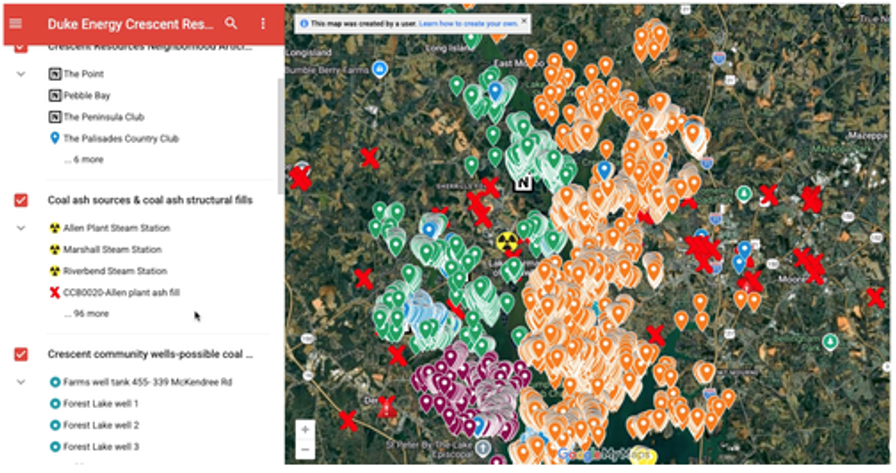
Example: Cancer cluster (orange, green, and purple points = recordings of cancer) around Lake Norman in Charlotte, NC, due to unlined coal ash receptacles and a Duke energy plant.
The good news is that advanced nuclear technologies may eventually become part of the solution. Abilene Christian University’s molten-salt reactor is one example of promising development, but cohesive research and demonstration is still years away. There are no immediate solutions for the wave of data centers being proposed and built today.
A responsible proposal must disclose the actual power source, timelines, emissions profile, water use tied to power generation, and whether existing ratepayers will carry any part of the cost. “Clean energy” should be used to describe real, verifiable power sources, not revived fossil fuel generation hidden behind a data center proposal.
Water: “Closed Loop” Is Not Enough
Water is one of the most important and misrepresented parts of data center development. Developers may say a facility uses a “closed loop” system, but that phrase alone does not tell residents enough. How much water is needed to fill the system? Will water be discharged? What chemicals are used? What happens during heat waves?
Many cooling systems involve biocides, corrosion inhibitors, heavy metals, mineral buildup, and wastewater discharge. Treatment can reduce contamination, but communities should not blindly accept vague assurances. The gold standard is not “closed loop,” but minimal freshwater withdrawal, full chemical disclosure, no routine discharge into local waterways, independent water testing, and enforceable penalties for violations. Newer cooling designs, including direct to chip cooling, dry coolers, and independently tested lower-toxicity immersion fluids may help reduce water demand, but they must always be verified locally.
Location, Location, Location
The physical location of a data center matters as much as the technology inside of it. A facility placed near homes, farmland, livestock operations, schools, senior housing, wetlands, or wildlife corridors can create permanent quality of life and environmental burdens. The impacts are not simply limited to what is inside the building.
Residents near data centers are already raising serious concerns about land clearing, water withdrawals, industrial lighting, constant low-frequency mechanical noise, traffic, diesel backup generators, and heat. In one 2026 Arizona State University study of data centers near Phoenix, researchers found that waste heat from data centers raised downwind air temperatures by an average of 1.4 to 1.6 degrees Fahrenheit, with some increases reaching up to 4 degrees. The heat effect was detectable up to about one third of a mile from the perimeter of the facility.
Those figures should be significant enough to matter in local zoning considerations. Responsible siting should mean no placement next to residential, agricultural, or ecologically sensitive areas. Abandoned industrial sites and existing warehouse zones may be more appropriate than bulldozing acres of rural fields, but only if the community impacts are fully addressed. If a site requires massive new infrastructure to make it viable, that is a warning sign, not a reason to push the project through.
Noise: Decibel Limits Are Not Enough
The impacts of noise are not necessarily about loudness alone. Data centers emit constant loud noise (10-20 is a nuisance and data centers emit 85-94 decibels), low-frequency sounds, vibrations, and tones from their equipment, creating a persistent hum that standard decibel limits may fail to capture, even when the noise can be heard from a considerable distance.
Chronic exposure to this type of noise is associated with biological stress to all forms of life. In humans, long-term noise exposure has been linked to cardiovascular impacts, stress response, mental health challenges, fragmented sleep, and other health concerns beyond hearing loss. Wildlife rely on sound (or lack thereof) to find habitat and mates, avoid predators, protect their young, and establish territory. The National Park Service notes that noisy environments can stress wild animals and alter behavior in birds, frogs, squirrels, primates, bats, and marine life.
The impacts can even ripple into plant communities. A recent Cal Poly study found 75 percent fewer pinon pine seedlings near a noisy natural gas compressor site than in quiet areas, and researchers also found that the ecological effects persisted even after the noise stopped. The likely reason was that scrub jays, which disperse pinon pine seeds, avoided the noisy areas.
Livestock should also be considered in rural siting decisions. A 2023 review on sounds in livestock farming found that environmental sound can affect animal welfare, and dairy cattle research has linked unfamiliar, excessive, or prolonged noise with stress and reduced performance. Stress from constant noise can also affect reproductive performance in cattle, including overall fertility.
Texas farmer and agricultural commissioner candidate Clayton Tucker reported that a ranch located near a data center, with approximately 50 head of cattle, “has not birthed a live calf in two years.” Similar anecdotal accounts are emerging from residents who say cattle have lost calves, chickens are laying fewer eggs, and horses are showing signs of severe stress near facilities producing persistent noise and low-frequency vibration.
Constant industrial noise and vibration should not be treated as a mere nuisance when it is proven to interfere with human health, animal welfare, and farm viability. A responsible project should require independent pre-construction acoustic modeling, baseline sound studies, post-construction monitoring, enforceable low-frequency limits, strict nighttime standards, and automatic penalties if the facility violates them. Trees and sound walls may help with some noise, but they should not be treated as a cure-all. Low-frequency sound often travels farther and penetrates barriers more easily than high-frequency sound.
Better Tech: Coming, But Not Here Yet
Much of the current data center burden comes from its heat cycle. Heat is a byproduct of running data center equipment, which drives the need for cooling. Cooling demand drives water use, noise, and power consumption.
Better technology, however, may be on the way. Companies including OpenAI, Meta, Microsoft, and NVIDIA are developing systems that use light, rather than copper wiring, to move data inside data centers. Because copper creates heat and uses energy, optical and photonic technology could help reduce power demand, cooling needs, water use, and noise. But it is important to note that this technology is not the standard for the projects being built today in our communities.
Technologies like copper wiring may help in the future, but they cannot be used to justify today’s permits. If a community is being asked to approve a data center now, the project should be judged by the technology it will actually use on day one, not by what may or may not exist three to five years from now.
Supply Chain: Little Parts, Big Problem
When a data center is used for ordinary commercial cloud storage, the supply chain question may seem distant from local zoning decisions. But when a facility is tied to military work, federal contracts, defense systems, healthcare or finance data, or other critical infrastructure, the origin of its components becomes a national security issue.
Local officials are asked to approve the land use, noise limits, water plans, and utility connections associated with a data center. They are not usually equipped to verify where the servers, chips, cameras, communications equipment, transformers, or other vital components actually came from. This is a troubling gap because federal law explicitly restricts certain Chinese-made telecommunications and surveillance components in projects involving federal agencies and contractors.
This does not mean every local data center is automatically violating federal law, nor does it make every component made in China categorically illegal. But Section 889 of the FY2019 National Defense Authorization Act (NDAA) prohibits the federal government from procuring or contracting for “any equipment, system, or service that uses covered telecommunications equipment or services as a substantial or essential component of any system, or as a critical technology as part of any system.” Federal contracting rules go even further, stating that this prohibition applies to a contractor’s use of covered equipment “regardless of whether that use is in performance of work under a Federal contract.”
Federal acquisition rules are also moving toward semiconductor restrictions. A proposed rule implementing Section 5949 of the FY2023 NDAA would prohibit federal agencies from procuring or obtaining certain electronic products or services that include covered semiconductor products or services tied to specific Chinese companies like Semiconductor Manufacturing International Corporation, ChangXin Memory Technologies, and Yangtze Memory Technologies Corp.
A responsible data center should supply supply-chain certification, even when a facility is not directly covered by those rules. National security should not be an afterthought buried beneath local site plans and technical filings.
Who Is Building Data Centers Responsibly?
The better question may be, “how long are we going to wait for widespread, enforceable standards so data centers are required to be built responsibly in the first place?”
A company can use better cooling technology at one facility while still pursuing problematic siting, power, subsidies, or infrastructure arrangements elsewhere. Microsoft, for example, is promoting its Fairwater AI data center in Wisconsin as a major closed-loop liquid project, saying that more than 90 percent of the facility will reply on a system filled during construction and recirculated continuously, while construction of a second “AI superfactory” is already underway and a 15-site expansion is planned.
NVIDIA is promoting newer liquid-cooled AI data center designs that it says dramatically reduce cooling tower water use. But better cooling does not erase the larger power problem of generating enough energy to power the data center boom. We still need to know where the electricity will come from, who will pay for the infrastructure upgrades, and what burdens will be created when high-density AI systems are deployed at scale.
Google has also announced a 2030 goal to replenish more freshwater than it consumes across its offices and data centers. But water stewardship commitments do not erase local water concerns in real time. Google’s data centers reportedly consumed 7.7 billion gallons of water globally in 2024, while public records in The Dalles, Oregon showed Google’s water use reached about 550 million gallons in 2025, nearly 40 percent of the city’s total water consumption.
These may be better practices, but they are not blank checks. A company can promote closed-loop cooling, water stewardship, or more efficient AI hardware while still raising serious questions about scale, siting, power, water, cost-shifting, and accountability.
Doing It Right
Communities should pressure local officials to pause approvals and enact protective standards. That may mean zoning restrictions, stronger setback requirements, water use limits, noise ordinances, infrastructure cost mandates, supply chain disclosures, or temporary moratoriums until more research, oversight, and public information are available. If a data center developer wants to claim it is building responsibly, the burden of proof should be on the developer, not the community.
Data centers may be a part of modern life, but that does not mean communities must blindly accept them. “Done right” cannot mean done fast, done cheaply, or done with public risk and private profit. If the industry wants trust, it must earn it before the first permit is approved, and before the first server goes online.