
 ™
™
A study submitted this year adds real weight to something many of us parents have been concerned about, and rightly so. This research study adds further evidence to the concern that the world's most widely used herbicide may be quietly reshaping our children's nervous systems.

The Results
Researchers from the Global Glyphosate Study, a multi-institutional research effort based at Italy’s Ramazzini Institute, just released a preprint, meaning the study has been submitted for publication but has not yet undergone formal peer review. The study examined what happens when rats are continuously exposed to glyphosate and two common commercial glyphosate-based herbicides—Roundup Bioflow and Ranger Pro—across three generations, beginning in the womb.
The doses used were not extreme. They ranged from the EU's "acceptable daily intake" up to the EU's "no observed adverse effect level," in other words, doses that regulators currently consider safe. Doses of which many scientists and doctors have already been sounding alarms.
The results: rats exposed to glyphosate and its commercial formulations showed a clear, dose-dependent pattern of increased anxiety-like behavior. They spent more time hugging the walls of a test arena instead of exploring, froze more often, and showed disrupted grooming patterns, all classic markers researchers use to measure anxiety in animals. The commercial herbicide formulations (which contain glyphosate plus other ingredients) caused even stronger effects than glyphosate alone, and males were generally more affected than females. The animals also showed modest reductions in grip strength, though motor coordination and short-term memory were unaffected.
This one study does not prove that glyphosate causes anxiety disorders in people. But it does not stand alone, either. It adds to a growing pile of animal and human research pointing in the same direction, at exposure levels that are supposed to be "safe." That is the part that should give us pause.
Both in the lab and in the observational studies of humans, it has been documented that repeated and persistent exposure to glyphosate and combination pesticides has been connected to increased anxiety, reduced social confidence, and a higher risk of metabolic dysfunction. Chronic exposure has been found to decrease working memory. Researchers found both a decrease in an enzyme called AChE (acetylcholinesterase), which helps nerve cells send signals correctly, and glyphosate exposure affected two antioxidant enzymes (SOD, superoxide dismutase, and peroxidase), which help clean up harmful waste produced by stressed cells. Not only is it a neurotoxin, it is interfering with the ability to clear toxins from the body. These are not minor side effects; they are real threats to quality of life for this generation and the ones that follow. Additionally, glyphosate exposure has been linked to reduced muscle mass and grip strength, and we know the importance of strength training for mental health and our aging adult population. Could this be another mechanism by which it contributes to anxiety disorders and depression?
Glyphosate exposure has been linked to decreased cognitive function and to anxiety and depression, including social anxiety. It has been found in farmers that glyphosate exposure impaired their capacity for visual memory in a statistically significant way. Motor coordination and complex attention problems were also studied, though not as significantly affected. Exactly how this happens is not fully understood yet, but the leading theories point to several overlapping pathways: disruption of gut health, impaired liver function, altered neurotransmitter and hormonal signaling, and glyphosate's broader tendency to increase inflammation throughout the body, placing extra strain on nearly every body system and putting our children at a disadvantage for their future mental and physical wellness.
Even if this exact paper does not survive peer review unchanged, here is another study that also found patterns of harm from exposure through generations. The broader body of evidence is already substantial enough to deserve our attention, and our children's health is not something we should wait decades to protect. Current backsliding of regulations through the EPA, court cases, bills trying to grant immunity to pesticide companies, and inadequate concern on the part of the Department of Health and Human Services, all suggest we as parents and concerned consumers need to speak up and take action.
"President Trump tasked Secretary Kennedy with finding the reason for the autism epidemic. He needs to look no further than glyphosate and vaccines. This new study, which confirms previous studies, shows once again that the exposure of glyphosate to animals leads to anxiety, which can contribute to autism. Glyphosate is in the majority of our conventional foods. Daily exposure is sure to contribute to our autism epidemic. Our anxiety epidemic is also affecting children as young as seven years old. There is enough scientific evidence to ban glyphosate. If the President won't ban it, we ask farmers to ban it from their fields. We are certainly banning glyphosate from our shopping carts and homes." -Zen Honeycutt, MAA
Why This Matters: The Real Cost of Anxiety
It may seem easy to treat "increased anxiety" as an abstract lab finding, but it is not. Anxiety disorders steal quality of life, affecting essential functions such as sleep, relationships, and the ability to enjoy things that used to feel easy.
Nearly 1 in 5 U.S. adults will experience an anxiety disorder significant enough to interfere with daily life, relationships, and simple enjoyment. And the picture for kids is getting worse, not better: among children ages 3–17, the number diagnosed with a mental, behavioral, or developmental disorder, which includes anxiety, depression, ADHD, and developmental and speech delays, climbed from 25.3 percent to 27.7 percent between 2016 and 2021, according to CDC data.
We know there are many contributing factors to that trend: increased screen use, isolation, academic pressure, a pandemic. Still, we owe it to our kids to look hard at every piece we can actually do something about. If a chemical this common is nudging the needle on anxiety even a little, that is not a footnote. That is a public health issue and an epidemic that we need to be sounding alarms about.
And it does not stop with humans. If exposure at "safe" doses is enough to shift behavior in lab rats, it is fair to ask what it is doing to wild rodents, the predators that eat them, and the fish and invertebrates living in waterways where glyphosate has already been detected. Here is a fish study showing embryonic exposure affected neurodevelopment in offspring. Glyphosate has even been found in rainwater. Do we really want to be adding to an already anxious world, in every species that shares it with us?
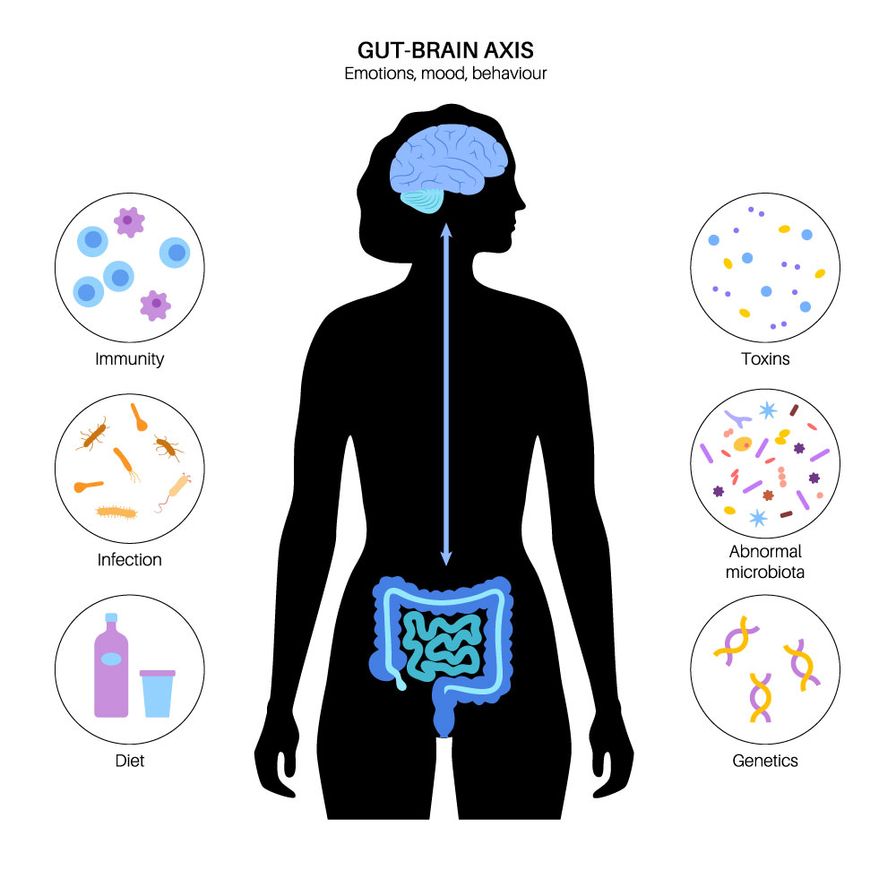
The Gut-Brain Connection
So how might a weed killer end up affecting the brain? One of the leading explanations researchers keep coming back to is the effects on the gut. Our body houses trillions of bacteria that help us with all aspects of health; they are essential to our wellbeing.
It is increasingly well established that the state of your gut microbiome directly shapes the health of your nervous system. This is referred to as the gut-brain axis. People with anxiety disorders frequently show measurable differences in their gut bacteria compared to people without anxiety, and clinical studies have found that restoring certain beneficial bacteria, like specific strains of Lactobacillus, can meaningfully reduce anxiety and depressive symptoms. Much of the body's serotonin, a neurotransmitter central to mood regulation, is actually produced in the gut, not the brain, which is part of why gut health and mental health are so tightly linked.
Glyphosate was originally patented as an antimicrobial, as well as an herbicide, and animal research, including work cited in this new study, has repeatedly linked glyphosate and glyphosate-based herbicide exposure to disruption of gut bacteria, altered serotonin pathway signaling, and increased inflammation. One study cited in the new paper found that low-dose glyphosate exposure during pregnancy altered gut microbiota in mouse offspring alongside epigenetic changes to a gene involved in serotonin production, right alongside the anxiety-like behavior the mice displayed. Other research has connected glyphosate exposure to disruption of the liver's detox pathways (the cytochrome P450 system), which the body relies on to clear both toxins and its own neurotransmitter byproducts, another plausible thread connecting glyphosate exposure to anxiety and to complications in managing anxiety and depression medically. Glyphosate and pesticide exposure could alter liver metabolism of medications, resulting in doses that are too high or too low and ineffective, resulting in additional and aggravated mental health issues.
Zoom out, and the same logic applies to the soil on which glyphosate is sprayed. Healthy soil, like a healthy gut, depends on thriving bacterial communities. Poisoning that soil does not just affect this year's crop, it can ripple into waterways, disrupt the food chain, reduce nutritional value of the soil, and detrimentally affect our own gut ecosystems. For more information about glyphosate and health risks, check out the book, Toxic Legacy, by Dr. Stephanie Seneff, Ph.D.
What You Can Do
If you or your child has been given an anxiety diagnosis, or if you are anxious to help prevent this, research like this is one more reason to take a look at diet and environmental exposure alongside whatever else you're already doing:
- Review your food. Consider swapping out high-glyphosate-residue foods where you can to organic. [Link: Moms Across America glyphosate food testing results]
- Rethink snacks. Instead of conventional crackers like Goldfish, look at options like organic Simple Mills. [Link: 100 better options instead of Goldfish crackers] Talk to your kids about why, so they can start making informed choices themselves.
- Support gut health. Prebiotic and probiotic-rich foods have real evidence behind them for reducing anxiety symptoms.
- Let kids play in the dirt—just steer clear of pesticide-treated playgrounds. Some counties and states already restrict pesticide use on playgrounds; it is worth asking your town council where your weed control policies currently stand and advocate for changes if needed. (Print and bring this article to help educate them about the importance of limiting our children’s exposure to harmful chemicals.)
- Speak up at school. Advocate with your child's school lunch program for foods tested to be free of glyphosate residue and make sure they aren’t using weedkillers on the school grounds.
None of this requires panic. It requires attention, honest assessment, and a willingness to ask hard questions about what "safe" really means when the science keeps moving.