 ®
®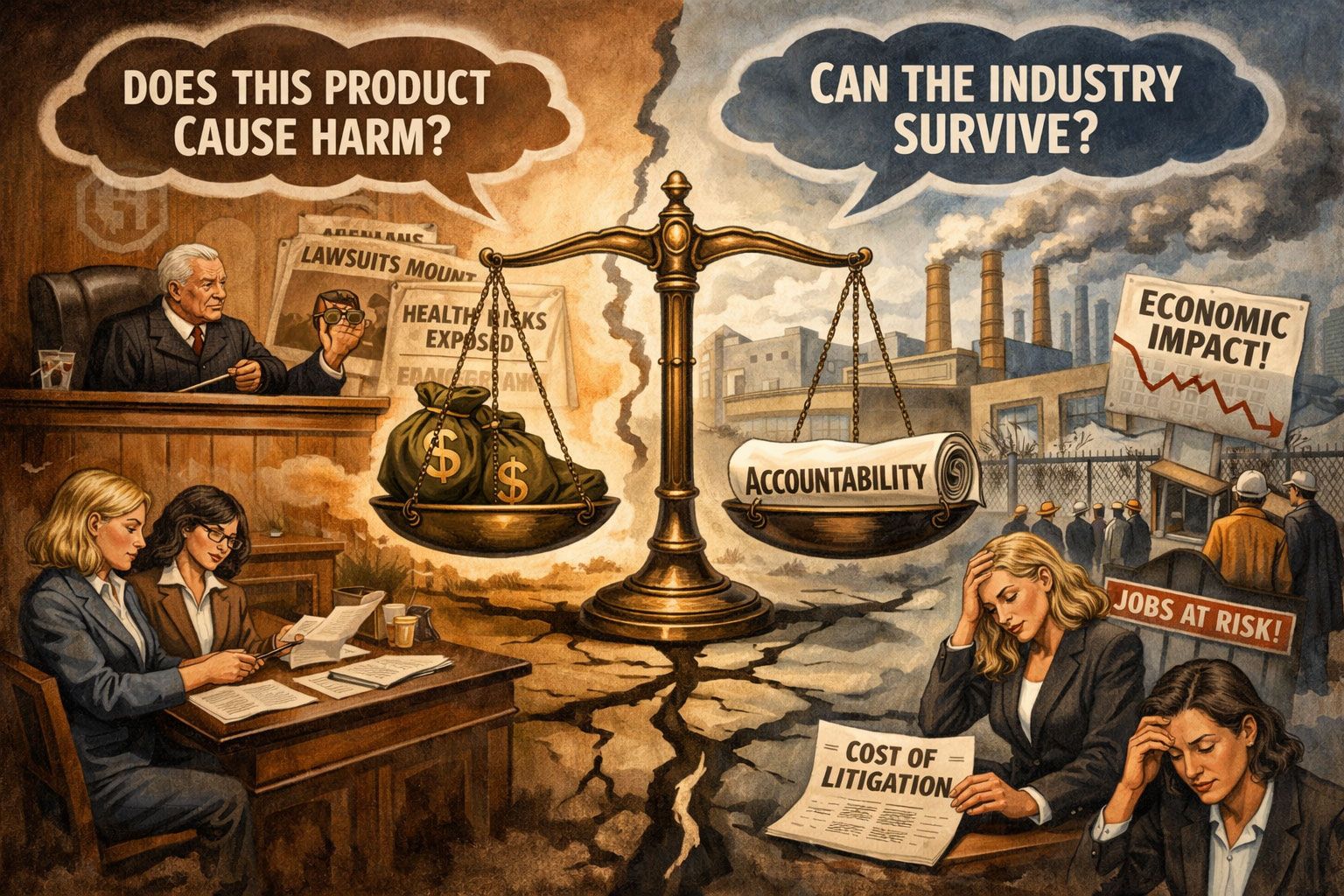
When a product deeply embedded in society is linked to widespread harm and begins to generate large waves of litigation, something interesting tends to happen in American regulatory history. The conversation often shifts away from the original question of “Does this product cause harm?” towards a very different type of inquiry: “What happens when the cost of accountability threatens the survival of the industry itself?”
From nuclear energy to cigarettes and vaccines, there are several points in U.S. history where the federal government has intervened when serious concerns about a product begin to accumulate, changing the rules about how the companies in question can be held responsible. Today, a similar situation is unfolding around glyphosate, the most widely used herbicide in the world. As thousands of lawsuits alleging links between glyphosate exposure and cancer move through the courts, chemical manufacturers and their allies have increasingly argued that existing federal pesticide regulations should protect them from liability. In other words, if the government approved the product and its label, should companies still be held responsible when people claim they were harmed?
The question carries enormous implications for American farmers and consumers, but it also highlights the much deeper issue about how American politicians respond when powerful corporations face the possibility of large-scale accountability for their products.
What’s Happening Right Now With Glyphosate
There is a heated liability debate unfolding around glyphosate, the active ingredient in the weedkiller Roundup®. Over the past decade, a growing body of research is linking glyphosate exposure to the development of non-Hodgkin lymphoma, a cancer of the lymphatic system. Meanwhile, pharmaceutical and agricultural giant Bayer, which acquired Roundup via its purchase of Monsanto in 2018, has mounted an aggressive legal defense as courts weigh whether the product’s cancer warnings were adequate.
The scale of this legal battle is enormous. Approximately 181,000 claims have been filed, and while more than $10 billion has already been paid to resolve earlier cases, tens of thousands of lawsuits remain active across the United States. In early 2026, a Missouri judge granted preliminary approval to a $7.25 billion settlement intended to resolve about 65,000 additional claims, illustrating the ongoing effort to contain the litigation.
And now, while the courts continue to evaluate claims of harm tied to glyphosate exposure, federal policy is simultaneously shifting to secure the chemical’s role in American agriculture. In February 2026, President Donald Trump signed an Executive Order invoking the Defense Production Act to prioritize domestic production of elemental phosphorus and glyphosate-based herbicides. The administration argues that maintaining a reliable supply of these chemicals is essential for national security and agricultural productivity. Under this act, Bayer is also protected from liability that could arise from complying with this government directive. This means that while glyphosate has not been granted full immunity as of yet, the groundwork to protect the pesticide industry is being laid.
These recent developments around glyphosate reveal the tension between corporate interests, human health, and how our government chooses to respond when the two collide. The dynamic: a mountain of litigation on one side and industrial protection on the other, mirrors patterns that have appeared repeatedly throughout U.S. regulatory history.
A Familiar Pattern in Regulatory History
When industries tied to potential public harm face large waves of litigation, the federal government sometimes intervenes to reshape how liability works for the product in question. Rather than allowing courts alone to determine corporate accountability, policymakers create alternative legal frameworks like liability caps, compensation systems, negotiated settlements, or financial stabilization programs to manage the consequences.
Each situation is different, but the underlying dilemma is often the same: What happens when holding a “systemically important” industry accountable would threaten survival of the industry itself?
History shows that when litigation threatens powerful industries, our government rarely leaves the outcome entirely to the courts.
Vaccines: The National Childhood Vaccine Injury Act
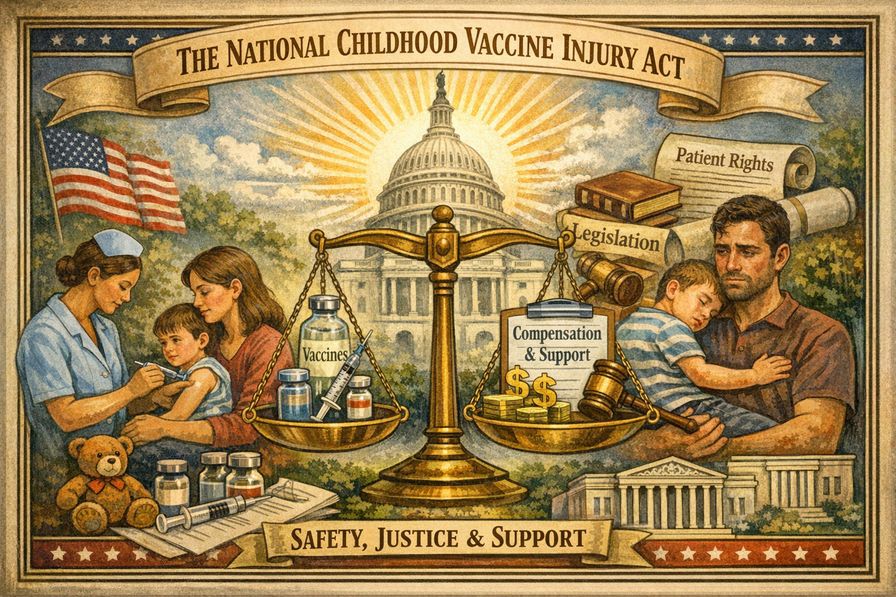
One of the most widely cited examples is the National Childhood Vaccine Injury Act (NVICA) of 1986.
During the late 1970s and early 1980s, vaccine manufacturers faced a rapidly growing number of lawsuits alleging injuries linked to the diphtheria-tetanus-pertussis (DTP) vaccine. By 1984, claims related to the DTP vaccine alone totaled roughly $1.3 billion, which was more than twenty times the vaccine’s annual sales. Liability insurance premiums rose sharply, and several manufacturers left the market entirely. By 1985, only one company that produced the pertussis vaccine remained in the United States. Out of desperation, vaccine manufacturers and their insurers urged the federal government to provide legal protection, citing that rising litigation and insurance costs threatened their ability to continue producing vaccines. This raised fear and concern among public health officials that the nation’s vaccine supply could collapse.
In 1986, Congress responded by passing the National Childhood Vaccine Injury Act. This act granted legal immunity to vaccine manufacturers and administrators, and created the Vaccine Injury Compensation Program (VICP), a no-fault system funded by a tax on each vaccine dose. Instead of filing traditional product-liability lawsuits against a corporation, individuals claiming vaccine injury submit a petition to a specialized federal court where compensation may be awarded from the federal fund.
Since the Vaccine Injury Compensation Program began operating in 1988, tens of thousands of petitions have been filed in the vaccine court. As of today, fewer than half of those claims have resulted in compensation, still totaling more than $5.5 billion in payouts. During that same period, the U.S. childhood immunization schedule has expanded six times over, from roughly a dozen recommended doses in the mid-1980s to more than seventy doses today. Public health authorities attribute this schedule expansion to advances in medical research, but critics of this liability-free framework argue that removing legal accountability also removes what historically ensures a product is safe and effective.
That tension remains active today. A recent court decision involving the American Academy of Pediatrics (AAP) has drawn renewed attention to how the vaccine schedule is governed, including a temporary pause on certain proposed changes to the childhood vaccine schedule while legal questions are resolved. The development underscores that, decades after NVICA, debates over oversight, liability, and decision-making authority in vaccination policy are still evolving.
Regardless of interpretation, the law illustrates a key point: When litigation alleging harm threatened the stability of domestic vaccine supply, Congress chose to restructure corporate liability rather than allow the legal system alone to determine outcomes.
Nuclear Energy: The Price-Anderson Act
A different version of the same dilemma appeared decades earlier in the nuclear industry.
In the 1950s, as the United States began developing civilian nuclear power, utility companies faced a major obstacle: private insurers were unwilling to cover the potentially enormous damages that could result from a catastrophic nuclear accident. Even though commercial nuclear power was still in its early stages, policymakers feared that the threat of unlimited liability would prevent private investment in nuclear energy altogether.
Congress responded with the Price-Anderson Act of 1957, which established a liability framework specifically for nuclear accidents. Under the law, nuclear operators are required to carry private insurance up to a specified level, after which a shared industry fund and federal backing provide additional compensation if damages exceed that amount.
The law effectively caps the liability exposure of nuclear operators while ensuring that funds are available to compensate victims if an accident occurs. Supporters of the act feel that this system allowed the nuclear industry to develop while still protecting the public, while critics have long argued that if an accident occurs and damages exceed the available compensation pool, the remaining costs could ultimately fall on taxpayers and affected families rather than the industry responsible for the accident.
Unlike the vaccine example, the Price-Anderson Act was largely preemptive, meaning it addressed potential liability before a large wave of lawsuits emerged. Yet it demonstrates the same core principle: When the potential cost of harm becomes too large for private markets to bear, governments sometimes restructure liability in order to support an industry’s viability.
Tobacco: The Master Settlement Agreement
Another major confrontation between corporate liability and public health emerged in the tobacco industry in the 1990s.
For decades, cigarette manufacturers faced a growing body of scientific evidence linking smoking to cancer, heart disease, and other serious illnesses. Beginning in the 1950s and accelerating in the following decades, researchers published studies establishing strong connections between tobacco use and long-term health risks. As public awareness grew, lawsuits against tobacco companies began to mount.
For many years, however, tobacco companies successfully defended themselves in court. Plaintiffs often struggled to prove that a specific company’s product had caused an individual’s illness, and cigarette manufacturers argued that the risks of smoking were widely known. That legal landscape began to change in the 1990s when U.S. states began to file lawsuits against major tobacco companies seeking reimbursement for Medicaid expenditures related to smoking-related diseases. The states argued that tobacco companies had not only sold harmful products, but had also engaged in decades-long campaigns to obscure the health risks of smoking. Faced with mounting litigation and the potential for enormous financial liability, the tobacco industry entered negotiations with state governments.
In 1998, the parties reached the Master Settlement Agreement (MSA), one of the largest civil settlements in American history. Under the agreement, tobacco companies agreed to pay the states more than $200 billion over the first 25 years, while also accepting restrictions on certain advertising and marketing practices, particularly those targeting youth.
This settlement reshaped the legal landscape of the tobacco industry. In addition to imposing massive financial penalties and new marketing restrictions, it also resolved large portions of state litigation and created a predictable framework for future legal claims. The Master Settlement Agreement illustrates another path governments have taken when confronting industries linked to widespread harm: rather than eliminating liability or allowing unlimited litigation, policymakers sometimes seek a negotiated settlement that reshapes the relationship between industry, consumers, and the courts.
Opioids: Bankruptcy and the Limits of Liability Shields
A more recent attempt to restructure corporate liability emerged during the opioid crisis, and the proposal quickly became one of the most controversial legal maneuvers in modern legal history.
Beginning in the late 1990s, prescription opioid medications such as OxyContin® were aggressively marketed as safe, less addictive treatments for chronic pain. As addiction rates rose and overdose deaths climbed, lawsuits began to emerge alleging that pharmaceutical companies like Purdue Pharma, the producers of OxyContin, had misrepresented the risks of opioid medications and encouraged widespread overprescribing. By the late 2010s, thousands of lawsuits had been filed by states, municipalities, tribal governments, hospital systems, and families seeking to recover costs associated with the opioid epidemic.
In 2019, Purdue Pharma filed for Chapter 11 bankruptcy, proposing a settlement that would resolve the growing wave of lawsuits through a structured compensation program that was funded by the company and members of Purdue’s owners, the Sackler family. The proposed settlement sought to channel claims into the bankruptcy process while granting the Sacklers broad legal protection from future liability related to the opioid crisis.
This legal battle ultimately reached the U.S. Supreme Court, which ruled in 2024 that bankruptcy law does not permit sweeping liability protections for non-bankrupt third parties, like the Sackler family members. Investigations revealed that as sales of OxyContin accelerated, members of the Sackler family collected roughly $10.7 billion in profit. For comparison, the broader economic cost of the opioid crisis has been estimated in the trillions of dollars, and the White House Council of Economic Advisers estimate the epidemic cost the United States approximately $2.5 trillion between 2015 and 2018 alone.
The settlement negotiations have required the Sackler family to pay approximately $6 billion toward resolving claims brought by states and local governments. While bankruptcy can reorganize a corporation and distribute compensation to victims, the courts have now ultimately rejected the attempt to use bankruptcy of a corporation to broadly extinguish legal claims against individuals who, have not themselves, declared bankruptcy.
The Purdue opioid litigation demonstrates that attempts to limit accountability in the face of widespread harm do not always succeed.
Banking and the “Too Big to Fail” Bailouts
A different version of this dilemma unfolded during the 2008 financial crisis, when the collapse of major financial institutions threatened to destabilize the global economy.
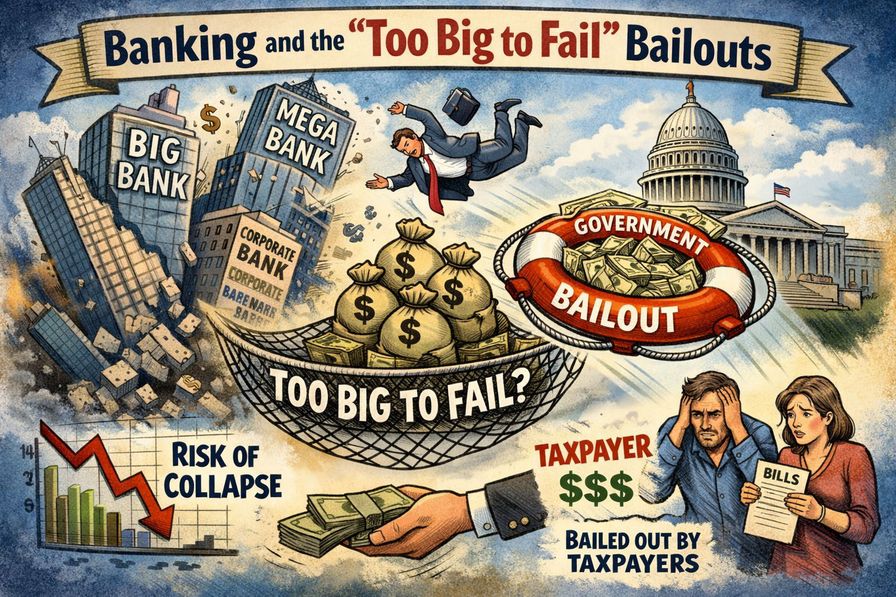
In the years leading up to the crisis, U.S. banks and financial institutions dramatically increased their lending to homebuyers. Much of this growth was driven by increasingly risky and sometimes predatory lending practices, including subprime mortgages issued to borrowers with weak credit, adjustable-rate loans with steep payment resets, and “no-documentation” loans that required little verification of income or assets. Mortgage loans were then bundled into complex financial products known as “mortgage-backed securities” and sold throughout the global financial system. When housing prices began to fall in 2007, large numbers of borrowers defaulted on their mortgages, rendering these securities nearly worthless and triggering a cascade of losses for banks and investment firms.
By late 2008, the situation had snowballed so out of control that investment bank Lehman Brothers collapsed, while other large firms, like AIG, Citigroup, and Bank of America faced severe liquidity crises. Fearing that a chain reaction of bank failures could lead to a global economic collapse, the federal government launched a series of emergency interventions. The most prominent was the Troubled Asset Relief Program (TARP), created through the Emergency Economic Stabilization Act. The program authorized up to $700 billion in taxpayer money to bail out the financial institutions and stabilize the economy. Studies of these emergency lending programs also estimate that the Fed provided trillions of dollars in short-term liquidity support to financial institutions during the crisis. According to the U.S. Treasury, most of these funds were eventually repaid, though the program remains one of the largest financial rescue efforts in American history.
Supporters of TARP argue that the government prevented a catastrophic economic collapse, while critics counter that the bailouts reinforced the perception that certain institutions are effectively “too big to fail,” creating an environment in which large corporations could take enormous risks while expecting government support if those risks threatened the broader economy.
While the financial crisis involved banks rather than consumer products, it reflected a similar policy dilemma seen in other industries: When the consequences of collapse become too severe, governments may intervene to preserve the stability of the system itself.
When Big Agriculture and Big Pharma Converge

Each of these historical examples followed a different path: compensation systems, liability caps, negotiated settlements, bankruptcy attempts, financial stabilization. Yet they all emerged from the same underlying tension: When allegations of harm collide with industries considered economically or strategically important, policymakers will sometimes decide what accountability should look like. The current debate surrounding glyphosate now raises that question once again. And there is one unusual aspect of the glyphosate debate: the company at the center of it.
Bayer, the manufacturer defending Roundup in court, is not simply an agricultural chemical producer. It is also one of the world’s largest pharmaceutical companies. Bayer acquired Monsanto, the company that developed Roundup, in 2018 during a $63 billion deal that created one of the largest life sciences conglomerates in the world. This new mega-entity combines crop science, pharmaceuticals, and consumer health products under a single corporate umbrella. Today, Bayer operates through several major divisions, including Crop Science, which produces agricultural chemicals and seeds, and Pharmaceuticals, which develops and markets prescription medicines for cardiovascular disease, cancer, and other chronic conditions.
This structure highlights an unusual reality of modern life: the same corporation can simultaneously participate in the production of widespread agricultural chemicals while also developing medicines intended to treat human disease.
To be clear, this overlap does not by itself prove that agricultural chemicals cause specific illnesses that pharmaceutical drugs later treat. Establishing direct causation in complex diseases often requires decades of scientific research. But the corporate structure itself illustrates how closely connected the agricultural and medical sectors have become within the global life sciences economy.
The glyphosate controversy therefore sits at the intersection of two enormous industries, agriculture and pharmaceuticals, whose products shape both the food system and the healthcare system. In that sense, the debate surrounding glyphosate is not only about one herbicide. As lawsuits continue to work their way through the courts, it is also about how our government determines corporate accountability when the same companies operate across multiple deeply embedded aspects of our lives.
The Accountability Question
From nuclear energy and vaccines, to cigarettes, opioids, and the housing market, these historical examples illustrate a recurring dilemma in American regulatory history. When an economically or socially important industry faces allegations of serious harm, the matter often shifts away from the usual due process of law and into: How do we decide what industry is “important” enough to protect from accountability? And how much accountability can the industry tolerate without being destroyed?
The glyphosate controversy is not only about toxicology or courtroom evidence. It is also about how central pesticides have become to modern farming and the global food system. The federal government has now signaled the importance of maintaining a stable supply of glyphosate-based herbicides by invoking the Defense Production Act, a move that highlights the tension between industrial systems that support modern life and the mechanisms used to hold those systems accountable when harm is alleged.
Whether the current debate over glyphosate ultimately leads to new liability protections, legislative reforms, or continued litigation, remains uncertain. But the pattern itself is familiar, and it leaves society confronting the same question that has surfaced time and again: What happens when holding a systemically important industry accountable threatens its survival?
What You Can Do
For citizens, farmers, and policymakers alike, the challenge is not simply choosing sides, but engaging seriously with the evidence, the legal process, and the broader systems that shape the food and agricultural economy. Here are some ways you can get involved:
- Support or engage with public petitions and advocacy efforts
Public petitions can play an important role in signaling concern and shaping policy discussions. For example, some advocacy groups are currently calling for a reevaluation of the 1986 vaccine liability framework. You can review and support initiatives such as the National Vaccine Information Center petition to repeal the 1986 law here:
https://www.vacsafety.org/petition-repeal-1986-law/
In addition to individual petitions, a number of organizations are actively working on issues related to glyphosate exposure, pesticide regulations, and food safety. These groups often lead public campaigns and support policies around food safety and health concerns. Notable organizations in this space include Moms Across America, Friends of the Earth, Children's Health Defense, The Center for Food Safety, Stand for Health Freedom, the Environmental Working Group, and Green America.
There is also an upcoming The People vs. Poison rally in Washington, DC on April 27, 2026. For those interested in participating, this event will offer an opportunity for you to engage directly in the ongoing conversation around pesticide policy and corporate accountability. - Contact your elected representatives about agricultural policy decisions
Major policies governing pesticide use and agricultural subsidies are often embedded within large legislative packages such as the Farm Bill. Contacting your congressional representatives and asking questions about how proposed legislation addresses pesticide regulation, liability, and public health can help ensure that these issues remain part of the policy conversation. - Follow the legal cases and regulatory developments
Many of these decisions are being shaped in real time through court rulings and regulatory actions. Following major cases, reading court summaries, and reviewing statements from agencies like the EPA or USDA can help you better understand how these issues are evolving and where public input may still influence outcomes.
Recent developments highlight just how active this landscape remains. As of April 2026, the Center for Food Safety and at least 16 other organizations have submitted an amicus brief in a case before the U.S. Supreme Court involving glyphosate liability. At the same time, newly released analyses continue to examine whether federal regulators have adequately warned the public about potential risks associated with pesticide exposure. These ongoing legal and scientific efforts suggest that key questions surrounding glyphosate and regulatory oversight are still being actively contested.